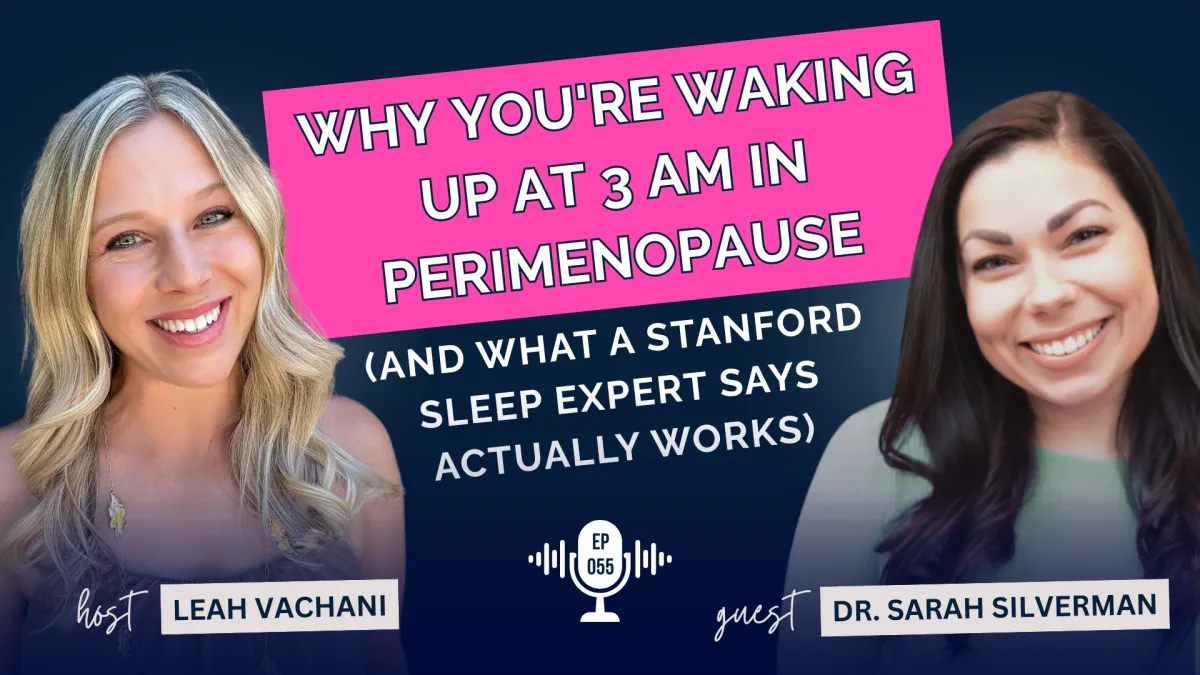
Why You're Waking Up at 3 AM in Perimenopause (And What a Stanford Sleep Expert Says Actually Works) ep#055
Summary
Why does perimenopause wreck sleep?
Sleep maintenance insomnia — the technical term for waking up in the middle of the night and not being able to fall back asleep — affects roughly 40 to 60 percent of women during the perimenopause and menopause transition. Dr. Sarah Silverman, a Stanford-trained behavioral sleep medicine specialist, calls it one of the most common things she sees in her practice with women in midlife.
The reason is hormonal, but not in the simple way most people think. Both progesterone and estrogen play a role. Progesterone, which has a calming, sedative effect on the nervous system, drops sharply in the luteal phase of the menstrual cycle and then declines overall through perimenopause. Estrogen helps regulate cortisol — your stress hormone — and as estrogen fluctuates, cortisol can spike in the early morning hours, often between 2 and 4 AM. That's the wake-up so many women describe.
Why melatonin probably isn't fixing it
Melatonin is one of the most reached-for sleep supplements in midlife. Here's the problem: melatonin is not actually a sleeping pill. It's a circadian rhythm regulator — it tells your body when it's time to sleep, not how to sleep. For perimenopausal sleep maintenance insomnia, that's the wrong tool. There's also a quality problem. A 2023 study published in JAMA tested 25 melatonin gummy products and found that 22 of them were inaccurately labeled — some containing as much as 347 percent of the dose stated on the bottle.
What actually works: CBT-I
Cognitive Behavioral Therapy for Insomnia, or CBT-I, is recommended as the first-line treatment for chronic insomnia by the American College of Physicians and the American Academy of Sleep Medicine. It's drug-free, short-term, and has been shown to be as effective as sleep medication in the short term and more effective in the long term.
One of the most powerful techniques inside CBT-I is called stimulus control. When you wake in the middle of the night and know sleep isn't coming back within 15 to 20 minutes, you get out of bed, leave the bedroom, and do something quiet and enjoyable until you feel sleepy again. The point is to retrain your brain to associate your bed with sleep — not with lying awake, anxious about not sleeping. Counterintuitive, but the research behind it is strong.
Temperature, sunlight, and the things that move the needle
A few other evidence-backed levers worth trying. Dropping your bedroom temperature below what you think is comfortable can reduce middle-of-the-night wake-ups. A 2019 meta-analysis in Sleep Medicine Reviews found that taking a warm bath or shower about 90 minutes before bed shortens the time it takes to fall asleep — the warming and subsequent cooling of core body temperature works with your circadian rhythm rather than against it.
And morning sunlight, ideally within the first hour of waking, is one of the most underrated sleep tools. Window glass filters out the wavelengths your brain needs, so it has to be outside or at minimum through a cracked window. Even 5 minutes counts.
The bottom line
Sleep in perimenopause is not a personal failing, and it's not something to white-knuckle through. The mechanisms are real, the evidence-based fixes exist, and the first one to try is often the simplest: wake up at the same time every day — yes, including weekends — and step outside for a few minutes of light. Your sleep changes after 40. Your strategy needs to change with it.
Where to Listen:
The information provided during this podcast is for educational purposes only. The speaker may be a licensed medical professional and may present case studies of actual patients or refer to patients' treatment during the program. Please be reminded that the Scope of Practice for Holistic Nutrition Professionals prevents us from diagnosing, preventing, treating, curing, prescribing, managing, or healing disease. Holistic Nutrition Professionals are not licensed in any state and work with clients, not patients.
Chapters
00:00 Introduction to Sleep and Wellness
02:24 Understanding Healthy Sleep
04:38 Gender Differences in Sleep Needs
06:43 Hormonal Influences on Sleep
13:11 Practical Strategies for Better Sleep
20:27 Fit Female Syndrome and Sleep Apnea
27:08 Chronotypes and Their Importance
30:20 Melatonin: Friend or Foe?
36:13 Alternative Sleep Aids and Tips
40:00 Foundational Sleep Practices
46:04 Closing Thoughts and Free Resources
About Dr. Sarah Silverman
Dr. Sarah Silverman, PsyD is a licensed clinical health psychologist and Stanford-trained behavioral sleep medicine specialist. She is a former Stanford Sleep Medicine Clinical Fellow, former Director of Behavioral Sleep Medicine at Montefiore Medical Center in the Bronx, and former Director of Behavioral Sleep Medicine at Tampa General Hospital. Her practice focuses on helping women — especially in midlife — sleep again without medication, using Cognitive Behavioral Therapy for Insomnia (CBT-I).
Connect with Dr. Sarah
→ Website: drsarahsleep.com
→Free Sleep Masterclass — 3 Steps to Up-Level Your Sleep Confidence: drsarahsleep.com
🔥 Resources/Links Mentioned:
🎙️ Submit YOUR podcast question here: https://www.speakpipe.com/LeahVachani or via written format here.
💌 Leah's Mailing List: https://leahvachani.com
💚 FullScript Dispensary: https://us.fullscript.com/welcome/lvachani (My community gets a 15% discount!)
💚 AG1 Greens - With my special link you will receive an exclusive subscription introductory offer worth $205 for only $79!
Connect with Leah...
✨ Follow Leah on Instagram for more value-packed content, tips, and lots of laughs! https://www.instagram.com/leahvachani/
✨ Subscribe to Women Aging Powerfully on YouTube for more free content. https://www.youtube.com/@WomenAgingPowerfully
✨ Join the free Women Aging Powerfully Facebook Community: https://www.facebook.com/groups/womenagingpowerfully
✨ Listen to the Women Aging Powerfully Podcast: https://leahvachani.com/podcast
✨ Lose that stubborn belly weight, reclaim your energy ALL day, sleep better, and feel amazing with Leah's signature course: https://leahvachani.com/cgm-reset-register-now
Sources & Research
Every research claim made in this episode, linked to its primary source:
CBT-I as first-line treatment for chronic insomnia: Qaseem et al., Annals of Internal Medicine (2016) — American College of Physicians clinical practice guideline
Sleep disturbance prevalence in perimenopause (40–60%): Stanford Lifestyle Medicine: How Perimenopause Affects Sleep
Melatonin gummy mislabeling (22 of 25 products): Cohen et al., JAMA (2023) — Quantity of Melatonin and CBD in Melatonin Gummies Sold in the US
Earlier melatonin labeling study (range -83% to +478%): Erland & Saxena, Journal of Clinical Sleep Medicine (2017)
Warm bath 90 minutes before bed: Haghayegh et al., Sleep Medicine Reviews (2019) — systematic review and meta-analysis
Sleep apnea risk in postmenopausal women (2–3× higher): Johns Hopkins Medicine — How Does Menopause Affect My Sleep?
Social jet lag (the term and its origin): Wittmann, Dinich, Merrow & Roenneberg, Chronobiology International (2006)
Magnesium for sleep — supportive evidence: Abbasi et al., Journal of Research in Medical Sciences (2012)
Perimenopause sleep maintenance insomnia (DSM-IV criteria study): Sleep Disturbance and Perimenopause: A Narrative Review (PubMed)
The information provided during this podcast is for educational purposes only. The speaker may be a licensed medical professional and may present case studies of actual patients or refer to patients' treatment during the program. Please be reminded that the Scope of Practice for Holistic Nutrition Professionals prevents us from diagnosing, preventing, treating, curing, prescribing, managing, or healing disease. Holistic Nutrition Professionals are not licensed in any state and work with clients, not patients.
NEED MORE HELP? Not sure where to start?
Here are some TOP resources to help you NOW!
STEP 1: Learn MORE from the Women Aging Powerfully Podcast
STEP 2: Connect with me on Instagram or Youtube, join the Women Aging Powerfully Facebook Community
STEP 3: Kickstart your weight loss goals and get epic results: The CGM Metabolic Makeover (Let's do this together!)
STEP 4: Lets chat about how I can further help you by booking a free