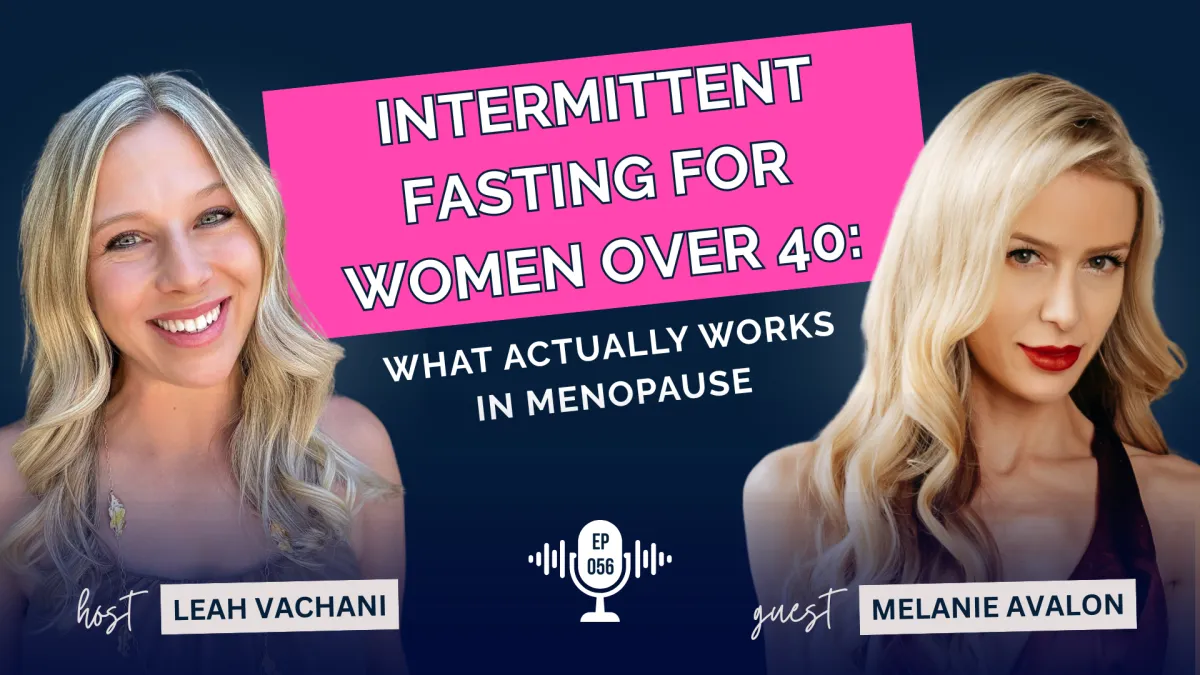
Intermittent Fasting for Women Over 40: What Actually Works in Perimenopause with Melanie Avalon #056
QUICK ANSWER
Intermittent fasting can work beautifully for women in perimenopause and menopause — and most of the fear surrounding it traces back to a single 2013 study on rats that were the developmental equivalent of nine-year-old girls (Kumar & Kaur, PLOS ONE). In actual midlife women, a 2022 trial from Dr. Krista Varady’s lab at UIC found that 8 weeks of time-restricted eating produced weight loss with no meaningful disruption to estrogen, progesterone, testosterone, or SHBG. The big lever isn’t the window — it’s protein, real food, and what you’re drinking during your fast.
The fear most women have about fasting comes from a study on baby rats
If you’ve hesitated to try intermittent fasting because someone told you it would wreck your hormones, you’re not alone. Almost every “women shouldn’t fast” warning circulating online points back to one 2013 paper. The rats in that study were three months old — the human equivalent of nine years old — and they were fasted for 24 hours every other day for twelve weeks. That’s not a regimen any midlife woman should be doing, and it’s not the regimen anyone is recommending.
What does the research on actual midlife women show?
When Dr. Krista Varady and her team — one of the most published intermittent-fasting researchers in the world — ran an 8-week trial of 4-hour and 6-hour eating windows in obese pre- and postmenopausal women, they found something quietly important. SHBG, testosterone, androstenedione, estradiol, estrone, and progesterone all stayed put. DHEA dropped by about 14%, but stayed within the normal range. Women in the fasting groups lost weight. Women in the control group didn’t. That’s the headline.
The DHEA drop is worth a conversation with your provider if you’re postmenopausal — DHEA is a precursor to estrogen, and you’re already losing a lot of it. But the broad-strokes finding is that daily time-restricted eating doesn’t do the hormonal damage people have feared. (Multi-day water fasts are a different conversation.)
What actually breaks a fast?
This is where most women get tripped up. The short answer from Melanie: anything that signals “food” to your body breaks the fast — even if it’s technically “zero calories.” Stevia, monk fruit, lemon water, MCT oil, butter in coffee, that little splash of cream — all of it sends a hormonal signal that you’re eating, which raises insulin or stops autophagy. The only true clean-fasting drinks are water, black coffee, and unsweetened tea.
The midlife angle: protein, not protocols
Here’s where I want to lean in as a menopause specialist. The single biggest lever for women in their 40s, 50s, and 60s isn’t the fasting window. It’s protein. Most of the women I work with are eating roughly half of what their body actually needs. Melanie is right that protein is the most thermogenic macro and the most satiating — which makes it the highest-leverage change you can make at the same time as a fasting practice.
If you’re going to start somewhere, start there. A solid hand-sized portion of protein at every meal. Then think about a 12-hour overnight fast. Then — only if it’s pulling you toward feeling better, not worse — consider tightening that window.
Your body isn’t broken — it’s just been ignored.
Fasting isn’t magic. It’s a tool. And the women I see do best with it are the ones who treat it that way — who experiment, track for a couple of weeks (Melanie called this the observer effect, and it’s real), and figure out what their body actually responds to. Not what worked for the 30-year-old version of them.
Listen to the full conversation with Melanie on Spotify or YouTube, and if you’re ready to see what your blood sugar is actually doing during a fast, my next CGM Metabolic Makeover cohort opens for enrollment soon. Get on the waitlist now to lock in your spot.
Where to Listen:
The information provided during this podcast is for educational purposes only. The speaker may be a licensed medical professional and may present case studies of actual patients or refer to patients' treatment during the program. Please be reminded that the Scope of Practice for Holistic Nutrition Professionals prevents us from diagnosing, preventing, treating, curing, prescribing, managing, or healing disease. Holistic Nutrition Professionals are not licensed in any state and work with clients, not patients.
Chapters
00:00 Introduction
01:16 Understanding EMF and Health Concerns
01:55 Introduction to Intermittent Fasting
04:56 Different Approaches to Intermittent Fasting
12:00 Intermittent Fasting and Hormonal Changes
19:20 Understanding Intermittent Fasting and Diet Choices
28:17 The Role of Macros in Women's Health
37:15 Supplements to Enhance Fasting Benefits
About Melanie Avalon
Melanie Avalon, a leading health influencer, captivates thousands with her podcasts, “The Melanie Avalon Biohacking Podcast” and “The Intermittent Fasting Podcast,” amassing millions of downloads. Her journey into health and wellness began when she sought to address her own health issues, leading her to discover the world of biohacking and to become fascinated with optimizing her body for vitality and longevity.
With her background as a SAG-AFTRA actress, Melanie’s transition into this new realm was seamless, fueling her desire to share her passion with others. Today, she hosts a deeply engaged audience and community, interviewing some of the most respected names in health and wellness each week.
Melanie is the author of “What When Wine: Lose Weight and Feel Great with Paleo-Style Meals, Intermittent Fasting, and Wine” (W. W. Norton Countryman Press, 2018). She also created the top Apple app “Food Sense Guide” and launched the successful supplement line AvalonX.
Her work has been featured in numerous publications, including USA Today, Forbes, Entrepreneur, CNBC Make It!, LA Weekly, and Fox News.
Connect with Melanie
Website: melanieavalon.com
Find Your IF Style — Melanie’s quiz: melanieavalon.com/ifquiz
AvalonX supplements (code LEAH for 10% off): avalonx.us
🔥 Resources/Links Mentioned:
Dr. Mindy Pelz’s book Fast Like a Girl
Dr. Krista Varady — researcher at the University of Illinois Chicago
Berberine and Serrapeptase (see Sources & Research below for clinical context)
🎙️ Submit YOUR podcast question here: https://www.speakpipe.com/LeahVachani or via written format here.
💌 Leah's Mailing List: https://leahvachani.com
💚 FullScript Dispensary: https://us.fullscript.com/welcome/lvachani (My community gets a 15% discount!)
💚 AG1 Greens - With my special link you will receive an exclusive subscription introductory offer worth $205 for only $79!
Connect with Leah...
✨ Follow Leah on Instagram for more value-packed content, tips, and lots of laughs! https://www.instagram.com/leahvachani/
✨ Subscribe to Women Aging Powerfully on YouTube for more free content. https://www.youtube.com/@WomenAgingPowerfully
✨ Join the free Women Aging Powerfully Facebook Community: https://www.facebook.com/groups/womenagingpowerfully
✨ Listen to the Women Aging Powerfully Podcast: https://leahvachani.com/podcast
✨ Lose that stubborn belly weight, reclaim your energy ALL day, sleep better, and feel amazing with Leah's signature course: https://leahvachani.com/cgm-reset-register-now
Sources & Research
The “fasting harms women’s hormones” rat study — Kumar S, Kaur G. “Intermittent fasting dietary restriction regimen negatively influences reproduction in young rats: A study of hypothalamo-hypophysial-gonadal axis.” PLOS ONE, 2013. Read the paper — Rats were 3 months old (developmental equivalent of a 9-year-old human) and fasted 24h every other day for 12 weeks.
Time-restricted eating in pre- and postmenopausal women — Kalam F, Akasheh RT, Cienfuegos S, et al. (Varady lab). “Effect of time-restricted eating on sex hormone levels in premenopausal and postmenopausal females.” Obesity, 2022. Read the paper — The 4-hour and 6-hour TRE study Melanie referenced.
Review of intermittent fasting and reproductive hormones in humans — Cienfuegos S, Corapi S, Gabel K, et al. “Effect of intermittent fasting on reproductive hormone levels in females and males: A review of human trials.” Nutrients, 2022. Read the review
Berberine vs. metformin meta-analysis — Liang Y, Xu X, Yin M, et al. “Berberine and metformin in the treatment of type 2 diabetes: A systematic review and meta-analysis.” Read the meta-analysis — Comparable glycemic outcomes; most trials small or in Chinese populations.
Serrapeptase — Bhagat S, Agarwal M, Roy V. “Serratiopeptidase: A systematic review of the existing evidence.” International Journal of Surgery, 2013. Read the systematic review — Concludes evidence is insufficient to support its use as an analgesic or health supplement; amyloid plaque findings come from rodent and in vitro studies, not human trials.
The information provided during this podcast is for educational purposes only. The speaker may be a licensed medical professional and may present case studies of actual patients or refer to patients' treatment during the program. Please be reminded that the Scope of Practice for Holistic Nutrition Professionals prevents us from diagnosing, preventing, treating, curing, prescribing, managing, or healing disease. Holistic Nutrition Professionals are not licensed in any state and work with clients, not patients.
NEED MORE HELP? Not sure where to start?
Here are some TOP resources to help you NOW!
STEP 1: Learn MORE from the Women Aging Powerfully Podcast
STEP 2: Connect with me on Instagram or Youtube, join the Women Aging Powerfully Facebook Community
STEP 3: Kickstart your weight loss goals and get epic results: The CGM Metabolic Makeover (Let's do this together!)
STEP 4: Lets chat about how I can further help you by booking a free