Is Fruit Healthy After 40? What Hibernating Bears and Perimenopause Reveal About Sugar
Quick Answer: Yes — fruit is one of the healthiest foods you can eat after 40. But year-round availability collides with declining estrogen in ways that change how fruit affects your body. Lean on berries year-round in small portions, treat sweeter fruits like bananas, mango, and grapes as seasonal, pair fruit with fat or protein, and eat it whole rather than juiced or blended. A continuous glucose monitor (CGM) is the most reliable way to write your own rules.
If you have spent ten minutes on wellness Instagram lately, the messaging around fruit is a mess. Fruit is candy. No — eat the rainbow. Modern bananas will ruin you. No — you will get scurvy without them. Somewhere in the middle of all the noise, you are standing in your kitchen with a bowl of grapes wondering whether you are looking at a snack or a sugar bomb.
Here is the part nobody on wellness Instagram is asking: it is not whether modern fruit is sweeter than what our ancestors ate. The real question is whether the human body was ever designed to eat fruit 365 days a year. That has a much clearer answer — and it changes the conversation entirely, especially if you are in perimenopause or menopause.
This is the conversation your doctor probably is not having with you. Most clinical visits focus on disease management, not the metabolic mismatch between an ancestral rhythm and a modern grocery store. So let's have it.
Is modern fruit really sweeter than what our ancestors ate?
It depends entirely on the fruit. Some have been bred into something dramatically sweeter than their wild ancestors. Bananas, watermelons, and modern grape varieties are noticeably sweeter than the wild versions. Strawberries as we know them are only about 275 years old — an accidental cross of two wild species (Fragaria virginiana from North America and Fragaria chiloensis from Chile) that came together in a Brittany garden in the 1750s. So yes, some of what is in your produce aisle is dramatically different from what your great-great-grandmother had access to.
But other fruits are less dramatic than the internet would have you believe. A 2015 peer-reviewed study comparing 364 wild and cultivated apple varieties found something interesting: what changed during apple domestication was not the sugar content — it was the acidity. Wild apples taste sour because they are packed with malic acid. Strip out the acid, and the same gram-by-gram sugar load registers as much sweeter on your tongue. A 2021 follow-up study confirmed the finding across 17 cultivars and three wild varieties.
Which means the gram-by-gram debate gives you a different answer depending on the fruit. But that debate misses the bigger picture: it does not actually matter for the body. What matters is when, how often, and with what your body sees that sugar.
What can hibernating bears teach us about insulin and fruit?
Bear with me — pun absolutely intended.
In late summer and fall, grizzly bears do something extraordinary. They gorge on berries and salmon, gaining more than a hundred pounds in just a few weeks. By the time hibernation hits, some bears have nearly doubled their spring weight. In a human, that kind of weight gain would cause metabolic chaos. In a bear, it is exactly by design.
Research at the Washington State University Bear Center has documented a remarkable seasonal pattern. During the fall feeding window, bears are highly insulin sensitive — every gram of sugar in those berries gets efficiently converted to stored fat. Then winter comes, the bear stops eating, and the body flips a switch. The cells become insulin resistant, which sounds bad until you realize it is precisely what releases their stored fat as fuel. Months of free energy, no eating required. Spring comes, the switch flips back, the fat is gone, and the cycle resets.
In a 2022 study, WSU researchers identified eight serum proteins that appear to drive this seasonal toggle. Versions of those proteins also exist in humans — which is why this research is being studied for diabetes applications. The takeaway for our purposes is bigger: in a healthy bear, insulin resistance is not a malfunction. It is a feature. A metabolic survival mechanism between feeding season and fasting season. The body uses it to switch from store-fat mode to burn-fat mode.
Our ancestors had a version of this rhythm too. They gorged on whatever ripened in the fall and ate sparsely through winter when there was no produce aisle to lean on. By spring, the stored fat had largely been burned through. The cycle was ready to repeat. That rhythm shaped human physiology over hundreds of thousands of years. Your body still expects it. The modern grocery store does not deliver it.
Why does fruit hit differently in perimenopause and menopause?
Now layer in the hormonal piece, because this is where the bear story stops being a curiosity and becomes deeply personal.
Estrogen helps cells respond to insulin properly. A 2021 mechanistic review in The American Journal of Pathology walks through exactly how this works: estrogen receptors in muscle, liver, and fat tissue all play a role in insulin signaling, and when estrogen drops, that signaling gets less efficient. The result is that the same banana that produced a barely-noticeable blip in your blood sugar at 25 can absolutely spike you at 50.
The evidence works in reverse too. A 2024 meta-analysis of 17 randomized controlled trials published through the Menopause Society found that hormone therapy significantly reduces insulin resistance in postmenopausal women. That is a powerful confirmation of the mechanism — estrogen protects insulin sensitivity, and losing it compromises that protection.
Combine that hormonal shift with year-round fruit availability — the permanent fall feeding signal — and you have a metabolism told to store, store, store fat constantly, in a body that is also less efficient at burning it. Two opposing forces, both working against you, neither of which is your fault.
This is why so many women in their late forties and fifties tell me: "I'm eating the same way I always did, but the weight is not coming off." That experience makes complete metabolic sense after 40. Your hormones changed. Your environment did not. Your body is being asked to be in fall feeding mode 365 days a year while becoming less able to switch out of it. This is not a willpower problem. It is biology meeting environment.
Which fruits are gentlest on blood sugar after 40?
Not all fruit affects blood sugar the same way. Here is a practical reference for sorting fruit by impact, based on typical sugar content per serving and where each fruit lands on the glycemic index. Glycemic load — which factors in portion size — is what actually matters for your body, and it varies more than people realize.
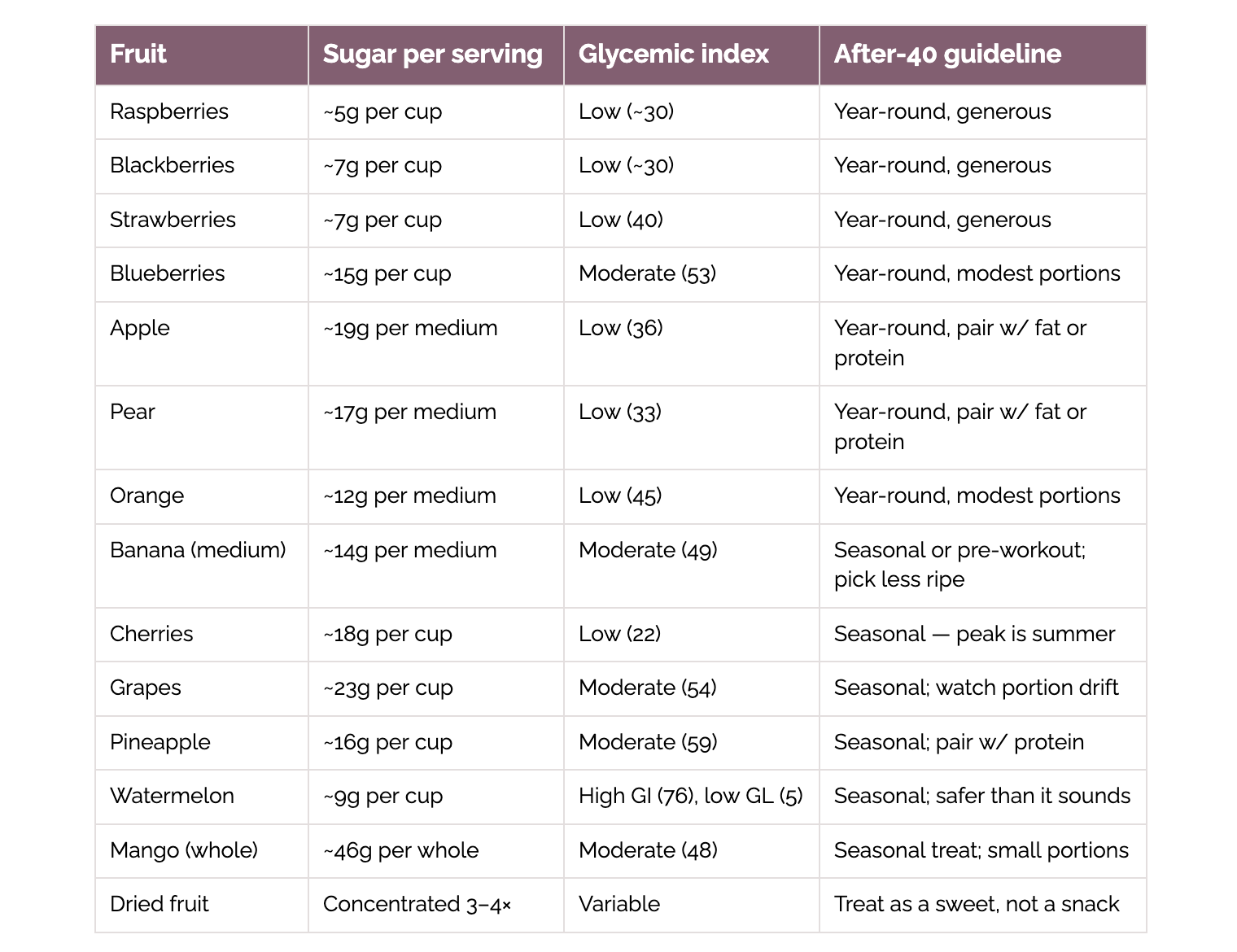
A note on watermelon: it has a high glycemic index of 76 because the sugar in it absorbs fast — but a typical serving contains so little carbohydrate that the actual impact on blood sugar (the glycemic load) is only about 5. That makes watermelon much gentler in practice than its scary-sounding GI suggests. The opposite is true of grapes: they look unassuming, but they are easy to eat by the cupful while watching TV. Portion drift makes them tougher on blood sugar than the numbers alone reveal.
How should women over 40 actually eat fruit?
Here is the framework I use with my clients. Six rules. None of them require eliminating fruit. All of them work with your biology rather than against it.
1. Berries are your year-round anchor.
Raspberries, blackberries, strawberries, and blueberries all clear the lowest-sugar bar. They are also the fruits richest in polyphenols — the plant compounds that support insulin sensitivity and cardiovascular health. A cup of mixed berries with breakfast or as an afternoon snack is the closest thing to a no-thinking-required fruit choice for women in midlife.
2. Treat sweeter fruits as seasonal.
Bananas, watermelon, mango, grapes, and pineapple are not bad fruits — they are seasonal fruits. Enjoy them in their actual season. Watermelon belongs to summer. Apples belong to fall. Mango is a tropical treat, not a daily smoothie ingredient. Your body was never designed to receive a tropical-fruit signal year-round.
3. Pair fruit with fat or protein.
Apple with almond butter. Berries with full-fat Greek yogurt. Pear with cheese. This is the "no naked carb" rule, and it slows the glucose response every single time. Even a small amount of fat or protein alongside fruit changes the curve. If you eat fruit alone, especially on an empty stomach, you will see a steeper spike than if you eat the same fruit with even a tablespoon of nut butter.
4. Eat fruit. Don't drink it.
Juice — even cold-pressed, even organic — strips the fiber that makes whole fruit metabolically gentle. The sugar hits your bloodstream much faster without the fiber matrix slowing it down. Smoothies can fall into the same trap if they are loaded with fruit. If you love smoothies, keep the fruit modest (a half cup of berries, not a banana plus mango plus pineapple), lean on protein and fat (Greek yogurt, nut butter, collagen), and treat the whole drink as a meal rather than a sip.
5. Watch portion drift.
A handful of grapes is not the same as the bag of grapes you eat while making dinner. A medium apple is one apple, not three you cut up and snack on across the afternoon. The fruit did not change. The portion did. Portion drift is the silent reason women tell me their "healthy snacking" is not moving the scale.
6. If you have a CGM, let your data write the rules.
More on this in the next section — but the short version is that your body is not your sister's body, not your best friend's body, and not the body of the influencer on Instagram telling you to fear bananas. Your data is the only data that matters.
How do I use CGM data to personalize my fruit choices?
A continuous glucose monitor (CGM) is a small sensor you wear on your arm that reads your blood glucose every few minutes for two weeks at a time. For women over 40 trying to understand which fruits work for them and which do not, it is the single most empowering tool I have used with clients.
Here is what to look at when you eat fruit with a CGM on:
The peak. How high does your glucose go after the fruit? For women without diabetes, ideally the peak stays under about 140 mg/dL, though tighter ranges (under 120) are even better. A peak above 160 after fruit alone tells you something needs to change — the fruit, the portion, or the pairing.
The time to peak. Fast spikes (under 30 minutes) signal that the sugar is hitting fast and the fiber or pairing is not slowing it down. Slower, gentler rises mean the fiber and any fat or protein are doing their job.
The return to baseline. How long does it take to come back down? A glucose curve that drops cleanly back within 90 minutes is doing well. A flatter, slower decline — or a glucose level that stays elevated for hours — suggests insulin sensitivity is compromised.
The reactive drop. Sometimes you will see a spike, then a sharp drop below your starting baseline — what is called a reactive low. That drop is what makes you crave more sugar an hour later. It is also one of the clearest signs that the fruit (or how you ate it) was not metabolically friendly for your current biology.
Two weeks of CGM data with a few simple experiments — same banana eaten alone versus with almond butter, watermelon at lunch versus at dinner, half a cup of grapes versus a full cup — will teach you more about your individual fruit tolerance than any expert ever could. This is exactly what we do in the CGM Metabolic Makeover program. We use your real data to figure out what works for your body, so you stop guessing, stop fearing fruit, and stop fearing food in general.
Frequently asked questions
Should I cut fruit out completely to lose weight in perimenopause?
No. Whole fruit gives you fiber, polyphenols, and micronutrients that almost nothing else does as cleanly. The shift after 40 is not elimination — it is smarter timing, smaller portions, and pairing fruit with protein or fat. Cutting fruit entirely can backfire by removing one of the few sweet things in your diet that comes packaged with fiber and slow-release sugar.
Are smoothies bad for blood sugar in midlife?
Blended fruit hits your bloodstream faster than whole fruit because blending breaks up the fiber matrix that normally slows sugar absorption. If you love smoothies, keep the fruit modest (a half-cup of berries is plenty), lean heavily on protein and fat (Greek yogurt, nut butter, collagen, chia, avocado), and skip fruit juice as a base. The drink should look more like a meal than a dessert.
Which fruits are lowest in sugar?
Raspberries are the lowest at about 5 grams per cup, followed by blackberries and strawberries at around 7 grams per cup. Kiwi, citrus, and small portions of apple or pear come next. Mangoes, grapes, and pineapples sit at the higher end.
Is fruit juice as healthy as whole fruit?
No. Juicing removes the fiber that slows sugar absorption. Even cold-pressed, organic juice spikes glucose much faster than the whole fruit it came from. A glass of orange juice has the sugar of three to four oranges with none of the fiber to slow the impact.
Can I eat fruit if I am cutting carbs in perimenopause?
Yes — small portions of berries are the easiest to fit in. A half cup of raspberries adds about 3 grams of net carbs, which works on most lower-carb approaches. If you are targeting lower carbs to support insulin sensitivity, save sweeter fruits for occasional treats and let your own glucose data guide you.
Does fruit cause belly fat in menopause?
Fruit itself does not cause belly fat — chronically elevated insulin does. The fruit only becomes a problem when it is consumed in large quantities, year-round, alongside other sources of refined sugar, in a body where estrogen-driven insulin sensitivity is already declining. Address the bigger pattern, and a bowl of berries is not your enemy.
What is the best time of day to eat fruit?
Earlier in the day generally results in a smaller glucose response than late at night, because insulin sensitivity is naturally higher in the morning. After a meal that already contains fat and protein also produces a gentler curve than fruit on an empty stomach. If you tend toward evening sweet cravings, a small portion of berries with full-fat yogurt is usually a smarter choice than fruit alone.
Should I avoid fruit if I have insulin resistance?
No — but be more strategic. Stick to lower-sugar fruits (berries first), always pair with fat or protein, watch portions carefully, and skip juice and big smoothies. If you have access to a CGM, this is exactly the situation where the data is most valuable.
The bottom line
Fruit is not the enemy. Year-round, every-meal fruit consumption in a body that is losing estrogen — that is the actual mismatch. Lean on berries year-round. Save the sweet stuff for its season. Eat fruit whole. Pair it with fat or protein. Watch the portion creep. And if you have a CGM, let your data write the rules.
Your body isn't broken. It's just being asked to live in a fall that never ends.
Want to hear this conversation in long form? The Women Aging Powerfully Podcast episode #054 walks through the bear story, the ancestral context, and the framework in spoken word.
Listen to the episode on Spotify or YouTube — or see the full episode page with chapter markers and resources here.
READY TO USE YOUR DATA?
The CGM Metabolic Makeover is the program where we use your real glucose data to figure out what your body actually does — so you can stop guessing about fruit (and food in general) and start trusting yourself. Cohort #2 doors open May 25, 2026. Join the waitlist here.
ABOUT THE AUTHOR
Leah Vachani is a Certified Nutritionist, Menopause Specialist, and Metabolism Coach. She is the host of the Women Aging Powerfully Podcast, where she helps women 40+ understand the metabolic and hormonal shifts of perimenopause and menopause through clear, evidence-aware conversations. Her work focuses on insulin resistance, blood sugar regulation, and the everyday choices that actually move the needle.
EDITORIAL PROCESS
Every post on this site goes through a fact-check pass against primary sources before publishing. Research claims, study findings, and expert attributions are verified against the original published work. Sources are hyperlinked inline so you can read the science yourself.
SOURCES & RESEARCH
Ma B. et al. (2015). Comparative assessment of sugar and malic acid composition in cultivated and wild apples. Food Chemistry. View on PubMed
Yang X. et al. (2021). Effects of Genetic Background and Altitude on Sugars, Malic Acid and Ascorbic Acid in Fruits of Wild and Cultivated Apples. Foods. View on PubMed Central
Rigano K.S. et al. (2017). Life in the fat lane: seasonal regulation of insulin sensitivity, food intake, and adipose biology in brown bears. Journal of Comparative Physiology B. View on PubMed
Jansen H.T., Trojahn S., Saxton M.W. et al. (2019). Hibernation induces widespread transcriptional remodeling in metabolic tissues of the grizzly bear. Communications Biology. View on Nature.com
Saxton M.W., Perry B.W. et al. (2022). Serum factors regulate seasonal insulin sensitivity in brown bears. iScience. Coverage in Science magazine
De Paoli M., Zakharia A., Werstuck G.H. (2021). The Role of Estrogen in Insulin Resistance: A Review of Clinical and Preclinical Data. The American Journal of Pathology. View on ScienceDirect
Jiang Y. et al. (2024). Hormone therapy significantly reduces insulin resistance in postmenopausal women: meta-analysis of 17 RCTs. The Menopause Society. View press release
UCSF SugarScience. How Much Is Too Much? Average American consumption of added sugar. View at SugarScience.UCSF.edu
Royal Botanic Gardens, Kew. Garden strawberry (Fragaria × ananassa) history and origin. View at Kew.org
Resources/Links Mentioned:
🩸 CGM Metabolic Makeover program
🎙️ Submit YOUR podcast question here or via written format here.
💚 FullScript Dispensary (My community gets a special discount!)
💚 AG1 Greens - With my special link, you will receive an exclusive subscription introductory offer worth $205 for only $79!
Connect with Leah...
✨ Follow Leah on Instagram for more value-packed content, tips, and lots of laughs!
✨ Subscribe to Women Aging Powerfully on YouTube for more free content.
✨ Join the free Women Aging Powerfully Facebook Community
✨ Listen to the Women Aging Powerfully Podcast
✨ Lose that stubborn belly weight, reclaim your energy ALL day, sleep better, and feel amazing with Leah's signature course
The information provided during this podcast is for educational purposes only. The speaker may be a licensed medical professional and may present case studies of actual patients or refer to patients' treatment during the program. Please be reminded that the Scope of Practice for Holistic Nutrition Professionals prevents us from diagnosing, preventing, treating, curing, prescribing, managing, or healing disease. Holistic Nutrition Professionals are not licensed in any state and work with clients, not patients.
NEED MORE HELP? Not sure where to start?
Here are some TOP resources to help you NOW!
STEP 1: Learn MORE from the Women Aging Powerfully Podcast
STEP 2: Connect with me on Instagram or YouTube, join the Women Aging Powerfully Facebook Community
STEP 3: Kickstart your weight loss goals and get epic results: The CGM Metabolic Makeover (Let's do this together!)
STEP 4: Lets chat about how I can further help you by booking a free