How to Kick Sugar Addiction in Midlife with Jenn Edden #060
Quick Answer: Sugar cravings in perimenopause get stronger because two systems shift at the same time. Falling estrogen changes how the brain's dopamine reward pathway responds to food, and insulin climbs while blood sugar swings more widely through the day. Cravings then arrive as urgency rather than ordinary appetite. Steadying blood sugar quiets them far more reliably than willpower ever has.
You didn't used to be like this. That's the part women say with the most confusion in their voice. Twenty years ago there was cake in the office kitchen, you had a slice, and you forgot about it by three. Now there's a bag of something in the pantry and you know it's in there the way you know a phone is ringing in another room.
Something did change. It wasn't your character.
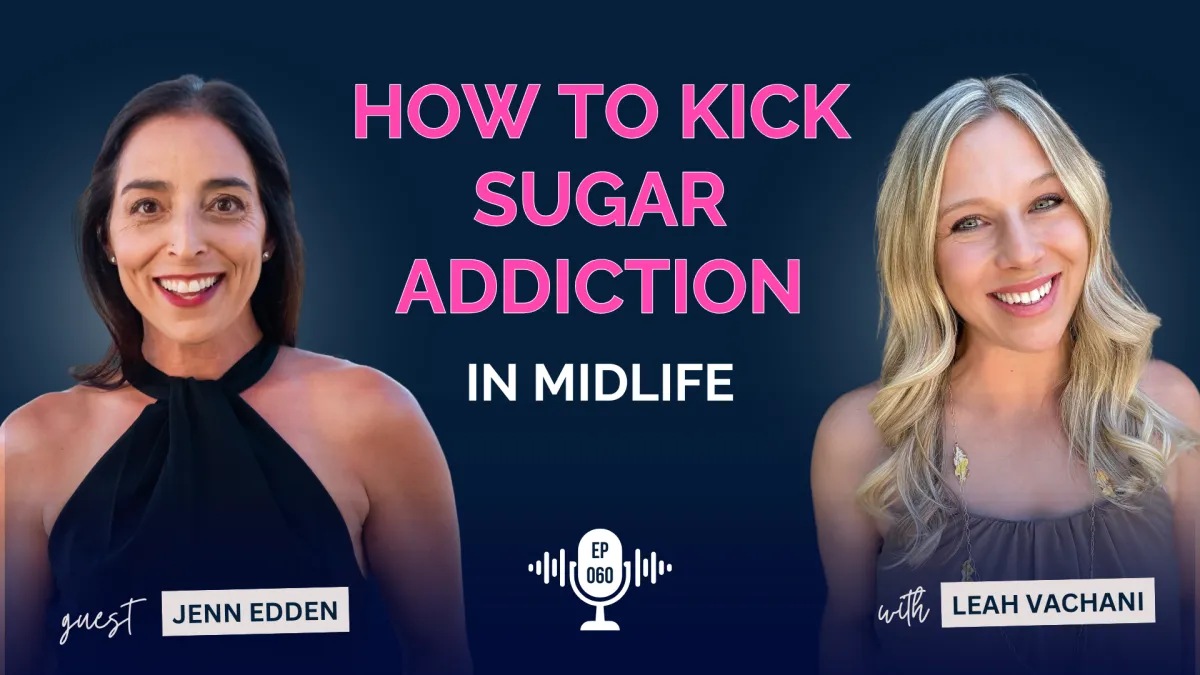
This week I'm joined by Jenn Edden, CHHC, a Board Certified Holistic Health Counselor, the founder of The Sugar Freedom Method® and the author of Woman Unleashed. She has spent more than 21 years working with women on cravings, and she came to the work through her own history with it. She also lost her father and had her husband of twenty-three years ask for a divorce three months later, and she came through that year without falling back into the eating patterns that once had her finishing a pint of ice cream in the car. How she did that turns out to be the throughline of the whole conversation.
Where to Listen:
The information provided during this podcast is for educational purposes only. The speaker may be a licensed medical professional and may present case studies of actual patients or refer to patients' treatment during the program. Please be reminded that the Scope of Practice for Holistic Nutrition Professionals prevents us from diagnosing, preventing, treating, curing, prescribing, managing, or healing disease. Holistic Nutrition Professionals are not licensed in any state and work with clients, not patients.
What causes sugar cravings in perimenopause?
Two systems shift at once. Estrogen, which helps regulate the brain's dopamine reward pathway, begins fluctuating and then declining. At the same time insulin sensitivity drops and blood sugar moves more widely across the day. You end up with a brain that gets less satisfaction from food and a bloodstream that keeps asking for more of it.
The estrogen piece is the one almost nobody explains. Estradiol modulates dopamine signalling in the striatum and nucleus accumbens, the parts of the brain that assign pull to a cue. Most of that work has been done in rodents, so I'm careful about how hard I lean on it, but it lines up with what women describe: the same cookie that used to be pleasant is now loud. Jenn's rule for where to start is blunt and I agree with it — she goes after the physiology first, because you cannot out-think a blood sugar signal.
Is sugar addiction real?
It's real enough to be measured and not official enough to be diagnosed. Food addiction isn't in the DSM-5, but researchers assess it with the Yale Food Addiction Scale, and pooled across studies roughly 14% of adults meet the threshold. The number that stopped me was the one broken out by age and sex: in a nationally representative US sample aged 50 to 80, 12.4% met criteria overall, 16.9% of women did, and among women aged 50 to 64 it was 21%.
One in five. Almost every one of them has spent years assuming she was the only one.
Why cravings hit hardest at night
Usually because of what happened at breakfast. A crossover trial from Heather Leidy's group found that only a 35-gram protein breakfast reduced evening snacking on high-fat foods, with less pre-dinner activation in the brain regions that drive food motivation. Two honest caveats: the participants were 18 to 20, and the study was industry-funded. But it matches what I watch happen on a CGM. Coffee and nothing else shows up as a jagged line all day. Eggs with avocado shows up as a small rise and a return to flat.
The night sweats connection nobody mentions
This is the part of the episode I'd most want you to hear. Vasomotor symptoms track with insulin resistance, not just with estrogen. The SWAN analysis of 3,075 women found hot flashes and night sweats associated with a higher HOMA-IR score, independent of body weight, estradiol and FSH. A 2026 analysis in JCEM went further: fasting insulin measured at age 47 predicted both earlier onset and longer duration of symptoms.
These are associations, not proof, and nobody should be told they can eat their way out of hot flashes. But if you've been told your night sweats are purely hormonal and there's nothing to do but wait, that isn't the whole picture — and the missing half is something you can measure.
Can you moderate, or do you have to quit?
Jenn and I don't fully agree here, and we left the disagreement in. She teaches that most women can learn to regulate once the physiology is steady. I've worked with women for whom that isn't true. Where I've landed: test moderation from a stable base — enough protein, steady blood sugar, decent sleep — and you'll get an honest answer about which camp you're in. Test it from a chaotic base and you'll just conclude you're broken.
We also get into ultra-processed food and why it drives higher intake even when the nutrients are matched, HRT and GLP-1s and why the foundation has to come first, and the five-minute morning habit Jenn recommends to women who have no idea where to start.
Your body isn't broken — it's just been ignored.
In this episode
Why “you fall to the level of your systems” is the most useful thing Jenn said all episode
The breakfast rule that changes the 3pm crash and the 9pm cookie at the same time
What a CGM actually shows when you have coffee and nothing else
The research linking night sweats to insulin resistance, not just estrogen
Can you learn to moderate sugar after 40, or do some people have to quit?
Ultra-processed food, cravings, and the cake Jenn ate out of her own garbage
Why the hardest cases almost always share the same self-talk
HRT, GLP-1s, and why the foundation has to come first
Two five-minute habits for the woman who has no idea where to start
Content note: Jenn refers briefly to her own history of abuse and of disordered eating in this episode. It is not graphic, but please take care of yourself while listening.
Chapters
00:00 Show open
00:31 Why “I'm addicted to sugar” is the wrong story
02:08 Meet Jenn Edden
02:13 The year that tested everything
03:46 “You fall to the level of your systems”
04:41 The 90-minute morning routine that held
06:16 Inside the Sugar Freedom Method
06:55 Why breakfast is the first domino
08:38 What a CGM actually shows
09:57 When the craving is emotional
11:06 Where the passion comes from
12:43 A word from AG1
14:40 From a pint of ice cream to one cookie
15:15 There is no one pill
17:04 The cake in the garbage
17:50 Mike Collins, and where we disagree
19:20 Gut health and the microbiome
20:18 Why some people spiral up and others down
21:09 Forgiveness, and building from the wreckage
24:25 Is it easier to stay sick?
26:43 Why midlife women are the no-BS clients
28:47 Clean eating and the fishbowl
30:57 The line outside your liver
32:55 A word from Fullscript
34:39 The one thing the hardest cases share
36:25 Mirroring, rewiring, catching the thought
38:39 The cup of tea (and Leah's beads)
40:16 HRT, GLP-1s, and doing the foundation first
44:14 Two biohacks: the vibration plate and the tub
48:03 The five-minute rule
50:02 Woman Unleashed, free
51:00 Where to find Jenn
51:40 Clarity, and one last thing
Meet Jenn Edden
Jenn Edden, CHHC, has been a certified holistic health coach for more than 21 years. She is a sugar addiction expert, the founder of The Sugar Freedom Method®, the author of Woman Unleashed, and was a regular contributing health expert on Channel 12 News Long Island. She holds a BSc in biochemistry and did a brief stint in medical school before finding her way to this work.
Her focus is teaching women 40+ how to kick cravings and manage sugar addiction using her five-step trademarked process. She and her team work on bringing inflammation down in midlife so women can shed stubborn weight and feel good again, without deprivation, denial or counting macros.
Resources mentioned
Clarity: Understand Your Metabolic Sweet Spot — the 5-week program using your own real-time glucose data. Doors open Monday 31 August; the cohort starts 21 September.
Join the Clarity waitlist — first to hear when doors open
Inner Circle — twice-monthly membership community
Practitioner-grade supplements (magnesium comes up in this episode) — 15% community discount via Fullscript
Frequently asked questions
Why do I crave sugar in perimenopause?
Two systems shift at once. Falling estrogen changes how the brain's dopamine reward pathway responds to food, so eating delivers less satisfaction and more repetition. At the same time insulin sensitivity drops and blood sugar swings more widely through the day, and the dips arrive as urgency rather than ordinary hunger.
How do I stop sugar cravings in perimenopause?
Start with the physiology rather than with willpower. Eat 30 grams or more of protein within an hour of waking, remove one ultra-processed item from the house, and protect your sleep. Most women find the afternoon crash softens within about a week, and the evening pull follows it down.
Why do I crave sugar at night?
Night cravings usually trace back to the day's glucose pattern rather than to evening willpower. A low-protein or skipped breakfast produces wider blood sugar swings, and the accumulated dips show up as urgency in the evening. By 9pm you are finishing a chain reaction that started at 7am.
What should I eat for breakfast to stop sugar cravings?
Aim for 30 grams or more of protein — eggs, Greek yoghurt, leftover chicken, cottage cheese. In one crossover trial, only a 35-gram protein breakfast reduced evening snacking on high-fat foods; a cereal breakfast of the same calories did not. Coffee alone is the version that guarantees the afternoon crash.
Can sugar make night sweats worse?
Possibly, though the evidence is associational. Large SWAN cohort analyses found hot flashes and night sweats track with higher insulin resistance independently of body weight, and that fasting insulin at 47 predicts earlier and longer-lasting symptoms. Worth addressing, but not a treatment for vasomotor symptoms.
Is sugar addiction a real diagnosis?
Not formally — food addiction isn't in the DSM-5. It is measured with the Yale Food Addiction Scale, and roughly 14% of adults meet the threshold, rising to about 21% of women aged 50 to 64. The pattern is real and measurable even though the diagnosis isn't official.
Do I need to quit sugar completely?
Most women don't, but you'll get a more truthful answer once your foundation is steady. Try moderating from a base of adequate protein, stable blood sugar and decent sleep. If it still fails from there, that's meaningful, and a period of abstinence may serve you better.
Will HRT stop my sugar cravings?
It may help, since estrogen influences both insulin sensitivity and dopamine signalling, but it rarely resolves cravings on its own. Women tend to do best when eating pattern, blood sugar, movement, sleep and stress are addressed alongside hormone therapy rather than instead of it. That's a conversation for you and your prescriber.
About the author
Leah Vachani is a Certified Nutritionist, Menopause Specialist and Metabolism Coach, and the host of the Women Aging Powerfully Podcast. She works with women over 40 who have been handed a concerning lab result and no explanation, using real-time glucose data to connect the symptoms nobody has linked together. Her flagship program, Clarity: Understand Your Metabolic Sweet Spot, is a five-week coaching cohort built around each woman's own numbers. More about Leah.
Sources & Research
Direct links to the primary sources behind the claims in this episode.
Yoest KE, Cummings JA, Becker JB (2014). Estradiol, dopamine and motivation. Cent Nerv Syst Agents Med Chem 14(2):83–89. [link]
Mechanism for estradiol's modulation of dopamine in reward pathways. Primarily rodent work.
LaFata EM et al. (2024). Ultra-Processed Food Addiction: A Research Update. Current Obesity Reports. [link]
Global prevalence of ultra-processed food addiction, ~14% of adults.
Ultra-processed food addiction in a nationally representative sample of older adults in the USA. [link]
12.4% overall; 16.9% of women; 21% of women aged 50–64.
Pursey KM et al. (2014). The Prevalence of Food Addiction as Assessed by the Yale Food Addiction Scale. Nutrients 6(10):4552–90. [link]
Weighted mean prevalence 19.9%; higher in adults over 35 and in women.
Leidy HJ et al. (2013). Beneficial effects of a higher-protein breakfast… Am J Clin Nutr 97(4):677–88. [link]
35g protein breakfast reduced evening snacking and food-motivation brain activation. Industry-funded; participants aged 18–20.
Thurston RC et al. (2012). Vasomotor Symptoms and Insulin Resistance in SWAN. J Clin Endocrinol Metab 97(10):3487–94. [link]
n=3,075. Hot flashes and night sweats associated with higher HOMA-IR, independent of BMI.
Athar S et al. (2026). Insulin Levels Early in Perimenopause Inform Vasomotor Symptom Incidence. J Clin Endocrinol Metab. [link]
n=704. Fasting insulin at age 47 predicted earlier onset and longer duration of vasomotor symptoms.
Hall KD et al. (2019). Ultra-Processed Diets Cause Excess Calorie Intake and Weight Gain. Cell Metab 30(1):67–77. [link]
~508 kcal/day more intake and ~0.9kg weight gain over two weeks on the ultra-processed arm.
Gröber U et al. (2017). Myth or Reality — Transdermal Magnesium? Nutrients 9(8):813. [link]
Concluded that transdermal magnesium application is scientifically unsupported.
Whole-body vibration training in obese subjects: a systematic review (2018). [link]
Evidence for body composition and glucose regulation effects in specific populations.
Effects of whole-body vibration training on inflammatory markers and lipid profiles (2025). Systematic review and meta-analysis. [link]
Reductions in TNF-α, hs-CRP and triglycerides.
Jenn Edden, CHHC — professional background and credentials. [link]
Board Certified Holistic Health Counselor (AADP); BSc biochemistry; founder of The Sugar Freedom Method®; author of Woman Unleashed.
Medical disclaimer
A quick note from me: I'm a certified nutritionist and menopause specialist, but I'm not your doctor — and this podcast isn't a substitute for personalized medical care. The information here is meant to inform and empower you, not replace a conversation with your healthcare provider. Always check in with your team before making changes to your diet, supplements, or lifestyle. Take what serves you, leave what doesn't, and trust yourself.
Editorial note
Every episode page on this site is fact-checked against primary sources before publication. Research claims are linked to the original paper or interview, statistics are verified against the source, and anything that can't be confirmed is either flagged or removed. This page was reviewed on the date shown above.
NEED MORE HELP? Not sure where to start?
Here are some TOP resources to help you NOW!
STEP 1: Learn MORE from the Women Aging Powerfully Podcast
STEP 2: Connect with me on Instagram or YouTube, join the Women Aging Powerfully Community
STEP 3: Kickstart your weight loss goals and get epic results with my famous 5-week CGM program: Clarity (Let's do this together!)
STEP 4: Let's chat about how I can further help you by booking a free