How to get a CGM (without Diabetes) #065
How to Get a CGM (without Diabetes)
What is Costs, Where it Goes, and Who Can Get One
By Leah Vachani, Certified Nutritionist, Menopause Specialist and Metabolism Coach
Last reviewed: October 2026
Part 5 of 8 in The Blood Sugar & CGM Series — an eight-part series on blood sugar, continuous glucose monitors, and taking charge of your own metabolic health. Each post stands alone, though they build in order.
Quick Answer
Since 2024 you can buy a continuous glucose monitor in the US without a prescription. Expect roughly $90 to $100 for the four weeks at cash price, and note that the subscription price is usually lower than a one-off box and can be cancelled after your month, and check whether your HSA or FSA will cover it, because the over-the-counter sensors are listed as eligible. The sensor goes on the back of your upper arm, applies in seconds, and most people report it does not hurt. Wear it for four weeks: one week changing nothing so you get a true baseline, then three weeks of one change at a time, about a week each. Then take it off. Skip it if you use insulin or another glucose-lowering medication, if you have a history of problematic low blood sugar, or if you have an active or recent eating disorder. Age limits now differ by device — Stelo was cleared down to age 2 in June 2026, Abbott's remain 18 and over.
Where to Listen:
The information provided during this podcast is for educational purposes only. The speaker may be a licensed medical professional and may present case studies of actual patients or refer to patients' treatment during the program. Please be reminded that the Scope of Practice for Holistic Nutrition Professionals prevents us from diagnosing, preventing, treating, curing, prescribing, managing, or healing disease. Holistic Nutrition Professionals are not licensed in any state and work with clients, not patients.
Chapters
00:00 Intro
00:30 Today's the practical one
01:13 What a CGM actually is
03:01 Do you need a prescription?
04:28 Which one should you buy?
06:28 Who can see your data?
07:38 Will your phone run it?
08:47 A word from Fullscript
10:30 What does it cost?
12:18 Where it goes, does it hurt?
14:06 Placement and your warranty
15:22 Don't throw away the box
16:07 Keeping it from falling off
18:20 What happens on day one?
19:27 Change nothing in week one
20:39 How long do you wear it?
23:30 Who should skip this?
25:48 What to do first
28:03 Coming in part six
29:10 Ask Leah anything
Do you need a prescription for a CGM?
Not any more, and this is recent enough that most people have not caught up to it. For most of the time continuous glucose monitors have existed in the US, they were prescription-only — which in practice meant finding a clinician willing to write one for someone without a diabetes diagnosis.
On March 5, 2024 the FDA cleared the first glucose biosensor that can be sold over the counter, Dexcom's Stelo. Abbott's Lingo followed on May 29, 2024. You can now order one online, have it delivered, and wear it without a diagnosis, a prescription or an appointment.
The over-the-counter sensors are all cleared for people who do not use insulin. That is a safety boundary rather than a technicality — see who should skip this, below. Age limits now differ by device: Dexcom Stelo was cleared down to age 2 in June 2026, making it the first over-the-counter CGM available for children, while Abbott's remain adults 18 and over.
What does a CGM cost without insurance?
At cash price, roughly $90 to $100 for the four weeks as of October 2026, depending on which device and whether you buy a single sensor or subscribe. Each sensor runs about two weeks, so a month is generally two of them. Prescription devices cost considerably more at cash price — retail for a month of one of the common prescription sensors runs in the low $200s, and a pharmacy discount card brings that down but not into over-the-counter territory. The trade-off runs the other way on insurance: prescription devices may be covered for you, where the over-the-counter ones generally are not. Price yours at your own pharmacy rather than trusting a figure online, because cash prices vary a lot between pharmacies.
One practical note that is rarely mentioned: the subscription price is generally lower than buying a one-off box, and nothing prevents you subscribing, taking your four weeks, and then canceling. You are not locked in, and for a four-week experiment that is usually the cheapest route.
The more useful reframe is that this is not an indefinite subscription. For most people the useful period is four weeks and then it is done. You wear it, you find out what you came to find out, you take it off and you apply what you learned. Priced that way it is a one-off cost to answer a question, not a standing expense.
Can you use HSA or FSA money for a CGM?
Both over-the-counter manufacturers list their sensors as HSA and FSA eligible on their own product pages. That matters more than anything else in this article for a lot of people, because it means paying with money you have already set aside for health care and in most cases have not paid tax on.
Three practical notes. Your plan administrator makes the final call, not the manufacturer. Some plans will ask for a letter of medical necessity, which is a short note from a provider rather than an obstacle. And if your card is declined at checkout, do not conclude the item is ineligible — pay for it normally and submit for reimbursement, which is a separate process with a different person reviewing it.
I am a nutritionist, not an accountant, and none of this is tax advice. Check with your administrator.
Which CGM should you buy?
Any ranked list published today is wrong within a year, and for someone wearing a sensor for a month to learn about her own body, they will all show substantially the same things. Three questions decide it instead.
Do you need alarms? Neither Stelo nor Lingo alarms. If you take any glucose-lowering medication, or have any history of genuinely low blood sugar, you need the Dexcom G7 or the FreeStyle Libre 3 Plus, which means a prescription and your prescriber involved.
Is anyone going to look at the data with you? This is where the two over-the-counter devices genuinely differ. Stelo feeds Dexcom Clarity — a free web dashboard you log into with your Stelo account, which holds your history, lets you compare periods side by side, and makes it straightforward to share your month with a nutritionist or clinician. (No relation to my own Clarity program; the name collision is a coincidence.) Lingo keeps its history inside the app. You can export it, but the export is a list of numbers rather than a picture of anything, and there is currently no practical route for sharing Lingo data with a practitioner.
What phone do you have? Do not skip this one. Both run entirely off a phone app — there is no separate reader, which the prescription devices do offer — and the apps are fussier than people expect. As of the review date above, Lingo runs on an older Android than Stelo does, so an older phone may rule Stelo out entirely. This matters because sensors are essentially final sale: check your phone's software version against the manufacturer's compatibility page before you order, not after.
For reference, as of the review date above, two over-the-counter sensors are actually on sale in the US — Dexcom Stelo and Abbott Lingo. If you need alarms, the prescription route means the Dexcom G7 or the Abbott FreeStyle Libre 3 Plus. Those are the two names to take to your appointment, and both can also be used with a separate reader if you would rather not depend on a phone.
Where does a CGM go, and does it hurt?
The FDA-approved site is the back of the upper arm, over the triceps. Approved here means that is where the device was tested during clearance, not that it is the only place it functions — these sensors read interstitial fluid, which is everywhere, so the abdomen and chest are both used in practice.
One honest trade-off on alternative sites: if you contact customer service about a faulty sensor and report that it was placed somewhere other than the approved site, you may not receive a replacement.
The sensor applies with a plastic applicator in a couple of seconds. What goes under the skin is a filament around five millimeters long and roughly as thin as an acupuncture needle. It does not reach the bloodstream, and most people report that application does not hurt.
Place it on the arm you do not sleep on. The reason for that is covered in part six.
How do you stop a CGM falling off?
This is the most common way people waste money on a sensor. Once it comes off it cannot be reapplied, and whatever days were left on it are gone.
Oil is the enemy of medical adhesive. Wash the site with plain soap containing no moisturizer, let it dry completely, then wipe with plain rubbing alcohol — checking that the alcohol contains no fragrance oils.
Use no lotion near the site for the duration of the wear.
If the site is hairy, apply the bandage test: if removing a bandage from that patch would hurt, shave it first. Adhesion improves and removal is more comfortable.
If you sweat heavily, have oily skin, or tend to catch your arm on things, use an overpatch — a flexible adhesive patch worn over the top of the sensor, separate from the small one that comes in the box. The ones I use are Skin Grips (affiliate link). They cost very little against the price of losing a sensor early.
Beyond that you can shower, swim, exercise and travel with it.
Keep the box and the applicator
A sixty-second habit that can save you the price of a sensor. Before you open anything, photograph the box and the applicator so every number on them is readable — or keep both until your wear period is over.
Two numbers matter. On some devices the four-digit pairing code that connects the sensor to your phone is printed on the applicator, and without it that sensor cannot be started at all. And the serial number, printed on the box, is what the manufacturer asks for before replacing a sensor that fails or falls off early. Sensors do occasionally quit a day or two short, and replacements are generally free — but not if you have thrown away the only record of which sensor it was.
What should you expect in the first 24 hours?
A warm-up period of 30 to 60 minutes before the first reading, depending on the device — the app tells you when it is ready. After that, some people find the first day of readings is simply not reliable while the sensor settles, and the numbers can look strange in either direction for up to 24 hours.
So if day one looks alarming either way, do not act on it, do not interpret it, and do not go looking it up at one in the morning. Some people experience this and some do not. A reasonable approach, if you are prone to worrying at a number, is simply not to open the app at all for the first day.
One further instruction that matters more than any of the technical detail: do not change how you eat for the first few days. The instinct is to eat carefully so the line looks good, and it defeats the purpose. You cannot learn anything about your actual life if you stop living it the moment you start measuring. Establish your real baseline first, then run experiments against it.
How long should you wear a CGM?
Four weeks, structured as one week of observation followed by three weeks of experiments. That is two sensors, since each runs about two weeks, and they are generally sold in pairs.
Week one you change nothing. Eat, move and sleep exactly as you already do. A full week rather than a few days, because you need a weekday and a weekend — two different lives for most people — plus a night of poor sleep, a night of good sleep, and almost certainly a stressful day. Seeing what stress alone does to glucose, with no food involved, is frequently the most clarifying moment of the month.
Weeks two, three and four are for experiments: one change at a time, roughly a week each. That is the step most people get wrong — they change several things at once and then cannot tell which one worked. Three weeks gives you three experiments, which is enough to find what moves your particular numbers. Keep what works and stack the next change on top.
Then stop. Indefinite wear tends to go one of two ways, neither useful: the data stops being looked at, or it is looked at constantly and becomes a source of anxiety.
Who should not use a CGM?
Anyone using insulin. The over-the-counter devices are not cleared for you and do not carry the alarms you need.
Anyone on other glucose-lowering medication, or with a history of problematic low blood sugar. Same answer. This is a conversation with your prescriber and a prescription device.
Age limits now vary by device. Dexcom Stelo was cleared down to age 2 in June 2026; Abbott's over-the-counter sensors remain adults 18 and over. For anyone under 18, this should involve their pediatrician rather than an online order.
Anyone with an active or recent eating disorder, or a history of one. A CGM hands you a fresh number several times an hour, all day, for a month. Where food and numbers are already entangled, that is not information, it is fuel. If you want this anyway, do not do it alone.
If any of these describe you, that is not a verdict on your curiosity — it is one route being wrong for you. The blood work in part one tells you a great deal and hands you a handful of numbers once, rather than thousands over a month.
What to do this week
Decide, rather than researching it for another three months. A decision either way beats another year of wondering.
If yes: check your phone against the device compatibility list, and check your HSA or FSA balance. Five minutes each, and between them they tell you whether this is straightforward for you.
Before it arrives, write down three questions you want answered — does my usual breakfast do something to me, what does a glass of wine with dinner do, what is happening at three in the morning. A month of data with no question attached is just numbers.
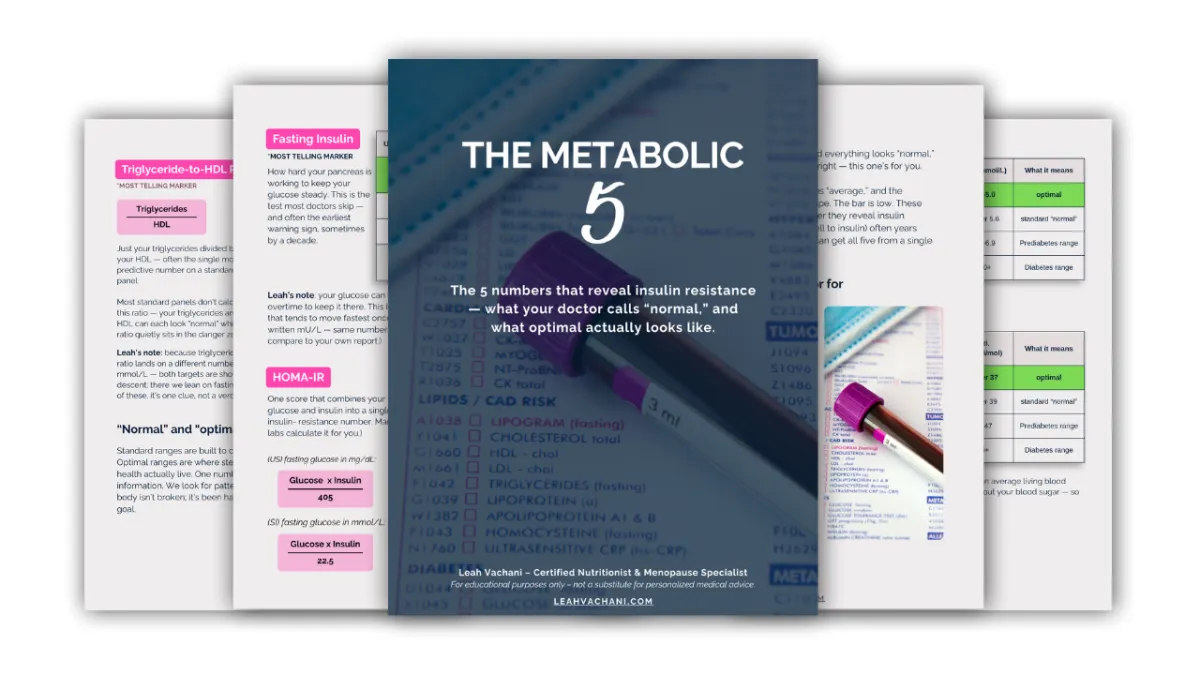
If no, or not yet: get the blood work instead. The five numbers worth asking for are in The Metabolic Five, free, with a printable list for your appointment.
Continue the series
This is part 5 of 8. Next: everything a CGM cannot tell you — the limits that matter before you spend the money, including the one hormone this whole series has been about that the device cannot measure.
See all eight episodes in The Blood Sugar & CGM Series
Resources
Ask Leah Anything — record a question and I'll answer it on air in a future Q&A episode. Record your question. Or type it instead.
The Metabolic Five — my free guide to every metabolic test worth asking for, including the fasting insulin nobody offers you, and a printable list for your appointment. Download it free.
Clarity — my program for reading your own real-time glucose data. On your own, in a small group, or one-on-one with me. See what is open.
The Inner Circle — my monthly membership for women who want ongoing support. Join here.
Free Community — come and join us, no cost. Join here.
Fullscript — my practitioner dispensary, 15% community discount. Shop here.
AG1 — the greens powder I use daily. See it here.
AFFILIATE DISCLOSURE: Some of the links above are affiliate links, which means I may earn a small commission if you purchase through them, at no additional cost to you. I only recommend products I genuinely use and trust.
Sources
FDA 510(k) clearances K234070 (Stelo, March 2024), K233655 (Abbott Lingo, decision date May 29, 2024) and K260935 (Stelo, June 12, 2026). Source for the clearance dates, the not-on-insulin indication, the absence of any glucose alerts, the 15-day Stelo wear period, and the 2026 clearance of Stelo down to age 2. Read it here.
diaTribe. FDA clears two new Abbott over-the-counter CGMs, June 2024. Source for Lingo being intended for people without diabetes, and for the timeline of both devices reaching general retail availability by the fall of 2024. Read it here.
Stelo by Dexcom and Abbott Lingo, manufacturer product pages. Source for current pricing, sensor wear duration and the HSA/FSA eligibility statements. Re-checked at the date of last review above. Read it here.
Stelo and Lingo smartphone compatibility pages, and Stelo's return and replacement policies. Source for the phone-version requirements, for Lingo running on an older Android than Stelo, for sensors being sold final sale, for the serial number and pairing code being required to process a replacement, and for the approved wear site being the back of the upper arm — which is what a manufacturer asks about before replacing a sensor. Read it here.
Kennedy K. Hack Your Blood Sugar, chapters 2, 8 and 9. Source for the filament dimensions, the FDA-approved placement site and the off-label alternatives, the skin-prep and adhesion guidance, the first-24-hours unreliability, and the caution on long-term wear tipping into hyper-focus on data.
Medical disclaimer
A quick note from me: I’m a certified nutritionist and menopause specialist, but I’m not your doctor — and this article isn’t a substitute for personalized medical care. The information here is meant to inform and empower you, not replace a conversation with your healthcare provider. Always check in with your team before making changes to your diet, supplements, or lifestyle. Take what serves you, leave what doesn’t, and trust yourself.