I Haven't Changed Anything. So Why Am I Gaining Weight? #062
Why Am I Gaining Weight in Perimenopause When Nothing Has Changed?
By Leah Vachani, Certified Nutritionist, Menopause Specialist and Metabolism Coach
Last reviewed: August 2026
Part 2 of 8 in The Blood Sugar & CGM Series — an eight-part series on blood sugar, continuous glucose monitors, and taking charge of your own metabolic health. Each post stands alone, though they build in order.
If you are in your forties or fifties, your eating and exercise have not changed, and the weight has crept up anyway — particularly around your middle — you may be in perimenopause without having been told. In one study of more than 7,600 US women, 42% of those aged 40 to 44 were unsure whether they had entered it. You do not need the label to recognise the picture.
Midlife weight gain is usually a late symptom rather than the first problem. Insulin — a storage hormone — rises for years before body composition changes, and four separate forces reduce your ability to clear glucose from your blood: falling estrogen, disrupted sleep, chronic stress, and declining muscle mass. A fifth, the ultra-processed food supply, acts from outside. Neither your scale nor a standard blood panel can detect any of it early.
Where to Listen:
The information provided during this podcast is for educational purposes only. The speaker may be a licensed medical professional and may present case studies of actual patients or refer to patients' treatment during the program. Please be reminded that the Scope of Practice for Holistic Nutrition Professionals prevents us from diagnosing, preventing, treating, curing, prescribing, managing, or healing disease. Holistic Nutrition Professionals are not licensed in any state and work with clients, not patients.
Chapters
00:00 Common misconceptions about women and weight
01:03 Blood sugar symptoms and their early signs
02:54 Why blood sugar and weight changes are late symptoms
03:22 Insulin's role in fat storage and metabolism
04:25 The pantry analogy for fat storage and release
05:22 Hormonal influences on blood sugar handling
07:14 Impact of surgical menopause on insulin resistance
08:50 Sleep deprivation's effect on insulin sensitivity
09:17 Stress hormones and blood sugar spikes
13:37 Muscle mass and its role in blood sugar regulation
15:35 How ultra-processed foods drive overeating and blood sugar issues
17:28 Limitations of scale and lab tests in detecting early issues
20:38 Practical tips: measuring waist and lifestyle changes
22:15 The cycle of visceral fat and insulin resistance
23:06 Actionable steps: focus on one area at a time
24:37 The future of blood sugar monitoring and personalized health
Why does weight gain show up late rather than first?
Because it is downstream of something else.
When your cells respond less well to insulin, your pancreas produces more of it. Insulin is a storage hormone — it promotes fat storage and inhibits its release. So when insulin runs high for years, you spend far more of your life in storage mode without changing anything about how you eat. The signal telling your body to store has simply been switched on more of the time.
This mirrors what happens on your lab work. As Ralph DeFronzo has argued for decades, insulin resistance appears long before blood glucose rises — insulin compensates, and glucose stays normal until compensation begins to fail.
One honest caveat: the relationship between insulin and body fat runs in both directions, and researchers continue to debate how much travels each way. But the direction of travel is not seriously disputed. The sugar handling changes first, and the body shape follows.
Which means if you have spent five years attacking the weight, you have been attacking the last thing that happened.
What symptoms suggest a blood sugar problem?
Most women have several of these and have never had anyone connect them:
An afternoon energy crash, often around three o’clock, with strong cravings for something sweet
Waking at two or three in the morning for no identifiable reason
Becoming genuinely irritable when a meal runs late, in a way you did not used to
Needing a nap after lunch
Brain fog arriving roughly ninety minutes after eating
These are not separate complaints and they are not simply ageing. They are all consistent with glucose variability.
What causes insulin resistance in perimenopause?
Four forces, and what makes them hard to spot is that each one is modest on its own. They are not four separate midlife problems that happen to arrive together — they are four routes to the same destination, which is a reduced ability to move sugar out of your blood.
1. Falling estrogen
Estrogen supports your body’s response to insulin, so as it declines it takes more insulin to move the same sugar. There is genuine debate about how much of the midlife change is menopause and how much is ageing. The cleanest evidence that hormones are doing something independent comes from surgical menopause: when the ovaries are removed and the hormonal drop is sudden rather than gradual, the risk of insulin resistance rises.
Estrogen also influences where fat is stored. Before the transition it tends toward the hips and thighs; afterwards it shifts to the abdomen. In a four-year study using CT imaging, all women gained subcutaneous fat, but only those who actually became postmenopausal gained significant visceral fat.
2. Disrupted sleep
Falling estrogen disrupts sleep directly — night sweats, night waking, sleep that is technically long enough and restores nothing. This is a symptom of the transition, not a lapse in sleep hygiene.
And sleep loss measurably changes glucose handling. In a randomised crossover study, healthy adults given four nights of about 4.5 hours in bed, with food and activity held constant, showed a 16% drop in whole-body insulin sensitivity and roughly 30% in fat cells. That study was small — seven participants, six of them men, average age 23 — so it demonstrates the mechanism rather than measuring midlife women. But the broader finding that short sleep reduces insulin sensitivity has been replicated repeatedly.
A note on direction: poor sleep worsening insulin sensitivity is well supported. The reverse — that improving your blood sugar will resolve your sleep — is not, and in practice disrupted sleep in this population usually has other drivers worth investigating separately.
3. Chronic stress
Your body reads a run of short nights as a threat, so broken sleep generates stress hormones of its own — on top of a decade that often brings peak career demands, teenagers and aging parents at once.
Cortisol raises blood glucose directly. It signals the liver to produce glucose through gluconeogenesis and reduces glucose uptake in muscle and fat tissue. More sugar enters the bloodstream, less leaves it, and none of that requires eating anything. You can have a blood sugar problem on a day you ate nothing unusual.
4. Declining muscle
Cortisol also breaks muscle down, increasing protein breakdown and suppressing synthesis. And muscle matters here more than almost anyone explains: under insulin-stimulated conditions, roughly 80% of glucose disposal occurs in skeletal muscle. It is by far the largest destination your body has for sugar.
Think of muscle as storage space. Now count what has been drawing on it: the menopause transition, where lean mass begins declining about two years before the final period; broken sleep, which reduces how well the remaining muscle responds; cortisol, actively breaking it down; and reduced activity or a shift from resistance work to cardio, which fails to replace it.
Four forces pulling on the same tissue. The same meal you ate at thirty-five now has less room to go into, so more of it stays in your blood for longer. Nothing about the meal changed. The room changed.
5. And one from outside: the food supply
This one has nothing to do with your age. In a 2019 NIH inpatient trial, twenty adults spent two weeks on an ultra-processed diet and two weeks on an unprocessed one, with the diets matched for presented calories, sugar, fat, sodium and fibre. On the ultra-processed diet they ate about 500 calories a day more and gained weight.
The likely explanation is speed. A later analysis found participants consumed roughly 50% more calories per minute on the ultra-processed diet. Softer, more processed food requires less chewing and goes down faster than fullness signals can arrive.
Why didn’t my doctor or my scale catch this?
Two separate failures.
Your weight is a single number combining muscle, fat, bone and water, and it cannot distinguish between them. Through the menopause transition fat rises while muscle falls, and the two partly offset each other on the scale. The number creeps up about a pound and a half a year, as it has for years, while your body composition changes underneath.
And a standard blood panel measures fasting glucose, which stays normal while insulin quietly climbs to keep it there. Fasting insulin is not on the standard panel and is rarely ordered.
One number that cannot see the change, and one test looking too late.
What should I measure instead?
Your waist. A tape measure at the level of the belly button, without holding your breath. Under 35 inches for women, under 40 for men.
There are two kinds of body fat. Subcutaneous fat is the kind you can pinch — on your arms, thighs, and the soft part at your waistband. It is largely storage and relatively harmless. Visceral fat sits deeper, beneath the abdominal muscles and around the organs, and cannot be pinched.
Which surprises people: a soft belly you can grab a handful of is largely the harmless kind. A firm, hard, round abdomen can be the more concerning presentation.
Visceral fat is metabolically active, sends out inflammatory signals, and drains directly to the liver. Researchers still debate exactly how it causes harm, but not whether it worsens insulin resistance. That makes it both a consequence and a cause — worse glucose handling puts fat around the middle, and that fat worsens glucose handling further. A loop that feeds itself, which also means anything that interrupts it works in both directions.
What can I do this week?
Measure your waist and write the number down. Over the threshold is information, not a verdict.
Pick the one force most obviously broken in your life right now. If you have not slept properly in two years, start there rather than with your diet.
Slow one meal down — whichever you eat fastest. Fifteen minutes lets fullness signals catch up.
And the honest limit: none of this tells you what your blood sugar is actually doing. It tells you what is likely, based on research about women in general. It cannot tell you whether your particular breakfast spikes you, or how long you take to come back down. Two women can eat the same meal and get different answers.
Continue the series
This is part 2 of 8. Next: what insulin is actually doing, why it climbs for years before anything shows on a lab, and why the 3pm crash and the 2am wake-up turn out to be the same story. See the full series.
Resources
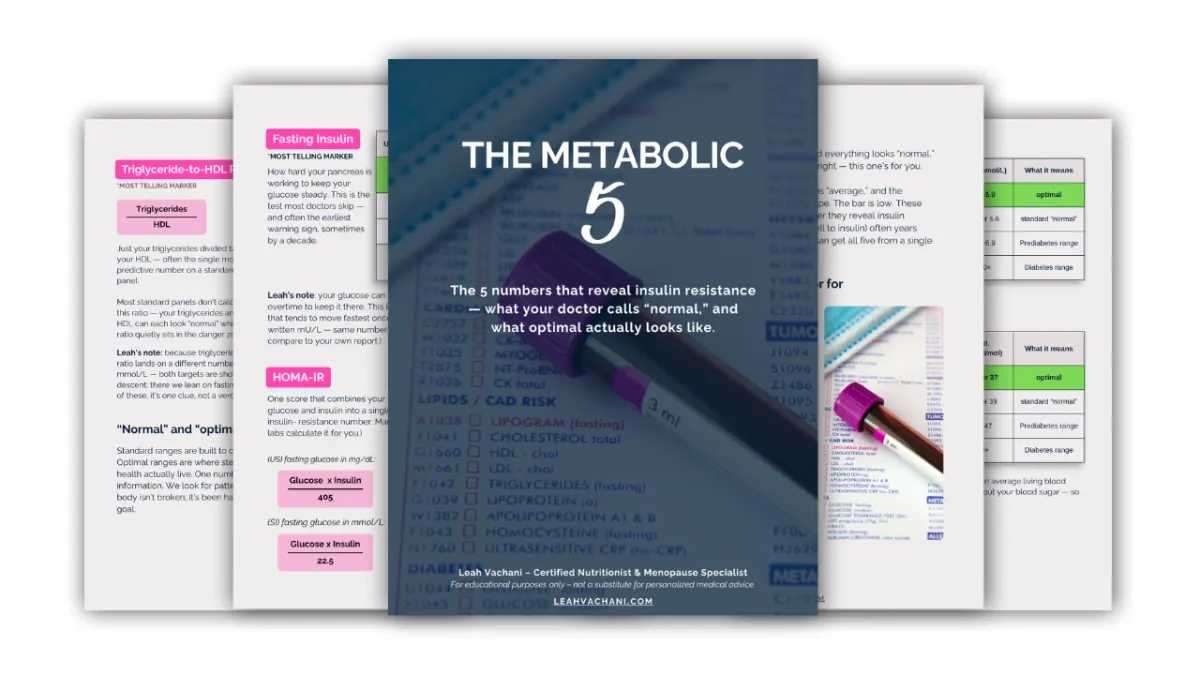
The Metabolic Five — my free guide to every metabolic test worth asking for, including the fasting insulin nobody offers you, and a printable list for your appointment. Download it here.
Clarity — my program for reading your own real-time glucose data. On your own, in a small group, or one-on-one with me. See current availability.
The Inner Circle — my monthly membership for women who want ongoing support. Join here.
Free Community — come and join us, no cost. Join here.
Fullscript — my practitioner dispensary, 15% community discount. Shop here.
AG1 — the multivitamin + mineral greens powder I use daily. See it here.
AFFILIATE DISCLOSURE: Some of the links above are affiliate links, which means I may earn a small commission if you purchase through them, at no additional cost to you. I only recommend products I genuinely use and trust.
Sources
DeFronzo RA, Tripathy D. Skeletal Muscle Insulin Resistance Is the Primary Defect in Type 2 Diabetes. Diabetes Care, 2009.
De Paoli M, Zakharia A, Werstuck GH. The Role of Estrogen in Insulin Resistance. The American Journal of Pathology, 2021.
Broussard JL, et al. Impaired Insulin Signaling in Human Adipocytes After Experimental Sleep Restriction. Annals of Internal Medicine, 2012.
Thau L, Gandhi J, Sharma S. Physiology, Cortisol. StatPearls.
Greendale GA, et al. Changes in body composition and weight during the menopause transition. JCI Insight, 2019.
Lovejoy JC, et al. Increased visceral fat and decreased energy expenditure during the menopausal transition. International Journal of Obesity, 2008.
Hall KD, et al. Ultra-Processed Diets Cause Excess Calorie Intake and Weight Gain. Cell Metabolism, 2019.
Forde CG, et al. Ultra-Processing or Oral Processing? Energy Density and Eating Rate. Current Developments in Nutrition, 2020.
Medical disclaimer
A quick note from me: I’m a certified nutritionist and menopause specialist, but I’m not your doctor — and this article isn’t a substitute for personalized medical care. The information here is meant to inform and empower you, not replace a conversation with your healthcare provider. Always check in with your team before making changes to your diet, supplements, or lifestyle. Take what serves you, leave what doesn’t, and trust yourself.