
Your Fasting Glucose and A1c Are Creeping Up. Nobody’s Worried?!? #063
What Does It Mean If My A1c Is Slowly Rising but Still Normal?
By Leah Vachani, Certified Nutritionist, Menopause Specialist and Metabolism Coach
Last reviewed: August 2026
Part 3 of 8 in The Blood Sugar & CGM Series — an eight-part series on blood sugar, continuous glucose monitors, and taking charge of your own metabolic health. Each post stands alone, though they build in order.
Quick Answer
An A1c between 5.5% and 5.7% is classified as normal, but carries a 9 to 25% chance of developing type 2 diabetes within five years. Diabetes risk rises steadily and continuously from an A1c of 5.0 upward, so 5.7 is a threshold drawn across a slope rather than a boundary in your body. A rising A1c usually means insulin has been compensating for years and is beginning to lose ground. The direction of travel matters more than any single result.
Where to Listen:
The information provided during this podcast is for educational purposes only. The speaker may be a licensed medical professional and may present case studies of actual patients or refer to patients' treatment during the program. Please be reminded that the Scope of Practice for Holistic Nutrition Professionals prevents us from diagnosing, preventing, treating, curing, prescribing, managing, or healing disease. Holistic Nutrition Professionals are not licensed in any state and work with clients, not patients.
Chapters
00:00 Diane's lab results, three years running
02:26 What your A1c actually measures
04:41 What the research says about a “normal” 5.6
06:18 Why there is no cliff at 5.7
09:11 The system detects thresholds, not trajectories
13:52 What was actually happening underneath
17:11 Insulin is a hormone. Nobody is discussing it.
19:07 What can make your A1c read falsely high
21:24 What to do this week
23:28 What you still cannot see
What is actually happening when my A1c creeps up?
Your A1c is not a snapshot of your blood sugar today. It is an average across roughly the last two to three months. Sugar attaches to your red blood cells, those cells live about 120 days, and measuring how glycated they are gives a rolling average of what your blood sugar has been doing.
So a number that moves from 5.4 to 5.5 to 5.6 over three years is not noise. It is a direction.
What drives that direction is usually insulin. When cells respond less well to insulin, the pancreas produces more, and that extra insulin keeps pushing glucose out of the blood — so blood sugar stays normal while the body works progressively harder to keep it there. Ralph DeFronzo has made this point for four decades: insulin resistance appears years, sometimes more than a decade, before blood glucose rises.
Which reframes what the drift represents. A rising A1c is not an early problem. It is a late signal of an older one — the point at which compensation begins to fail.
Is an A1c of 5.6 actually safe?
Officially it is normal. The American Diabetes Association classifies below 5.7% as normal, 5.7 to 6.4% as prediabetes, and 6.5% or above as diabetes. In my own practice I look for under 5.5% — because of what the research says about the gap between 5.5 and 5.7.
But a systematic review published in Diabetes Care found that people with an A1c between 5.5% and 6.0% have a 9 to 25% chance of developing type 2 diabetes within five years. Below 5.5% the risk falls under 9%. Above 6.0% it climbs to 25–50%.
Those figures have been challenged. A comment published in the same journal used Canadian screening data and reported lower five-year incidence — around 6% for the same band. The review authors replied that a single study cannot be compared against a pooled estimate from sixteen, and that reanalysing with the Canadian figures included changed their incidence curve very little.
So the honest range is roughly 6 to 25% over five years, depending on the population. Which end is closer to the truth matters less than it looks: even at the low end, that is around one in twenty women developing diabetes within five years from a result they were told was normal, with no conversation attached to it.
Why is the prediabetes cutoff set at 5.7?
Because a line has to go somewhere. It is a decision-making tool, not a description of biology.
The same review found diabetes risk rises steeply and continuously across the entire range from 5.0 to 6.5, with no discontinuity at 5.7. That is a slope, and 5.7 is a line drawn across it so clinicians have somewhere to begin.
Researchers continue to argue about the placement. One cohort of 2,778 non-diabetic adults found that people at 5.7–5.8% did not differ significantly in progression risk from those at or below 5.6%, and proposed 5.9% as a better cutoff.
The practical implication is not that the guidelines are wrong. It is that your body does not know where the line is. What matters for you is which direction you are moving, and how fast.
Why did my doctor not flag it?
Because the system is built to detect thresholds, not trajectories — and this is structural rather than a failure of any individual clinician.
At each appointment, a number comes back and is compared to a line. If it falls on the acceptable side, the result is marked normal and the visit moves on. Nobody places this year’s value beside last year’s and the year before to ask which direction it is going.
There is no field on the form for direction of travel, no billing code for drifting, and no alert that fires when a normal value has been becoming less normal for four years running.
For this to be caught, a clinician would need to open your chart, retrieve five years of results, order them, assess the direction, decide that direction is concerning despite every individual value being acceptable, and open a conversation about a condition you do not yet have — inside a fifteen-minute appointment that also has to cover everything else.
The consequence is that the warning arrives at the point of least opportunity. The years when this is most reversible are the years the system has nothing to say.
Insulin is a hormone. Why is nobody discussing it?
If you are a woman in your forties or fifties, you are likely being offered a detailed hormone conversation — estrogen, progesterone, possibly testosterone, whether to start hormone therapy and at what dose. That conversation is overdue and welcome.
Insulin is rarely part of it. It gets filed under blood sugar, which gets filed under diabetes, which is treated as a condition you either have or do not.
So a woman can be on well-managed hormone therapy, sleeping better and free of hot flushes, while her insulin climbs quietly with nobody watching it. She may conclude she has failed at something, when in fact she has treated one hormone well and never been told about the second.
This is not an argument against hormone therapy. It is an argument that there are two hormone conversations and only one is happening. They are also connected: estrogen supports insulin sensitivity, and when it declines, that response declines with it. The clearest evidence comes from surgical menopause, where the hormonal drop is sudden rather than gradual and the risk of insulin resistance rises.
Can anything make my A1c read falsely high?
Yes, and one cause matters particularly in perimenopause.
Because A1c depends on the lifespan of your red blood cells, anything affecting those cells affects the result. Iron deficiency raises A1c — making it read higher than your actual blood glucose warrants — and it does so even without full anaemia.
Heavy, prolonged or unpredictable menstrual bleeding is one of the defining features of the perimenopausal transition, and heavy menstrual bleeding is a leading cause of iron deficiency in women. So there is an ordinary situation in which a perimenopausal woman’s A1c reads higher than her glucose justifies, and nobody checks why.
Thyroid dysfunction and genetic variation in red cell lifespan can shift the result too.
None of this is a reason to dismiss a rising A1c. It is a reason to ask for ferritin alongside it if your periods are heavy — and one more argument for fasting insulin, which is unaffected by red cell turnover.
What should I do about a rising A1c?
Pull every result you have. Go into your patient portal, find every A1c and fasting glucose going back as far as it exists, and write them down in order. Then look at the direction. This takes ten minutes and does the one thing the system structurally cannot do for you.
Ask for fasting insulin at your next blood draw, by name. It is where this shows up first, it is not on a standard panel, and it is rarely ordered.
Ask for ferritin too if your periods are heavy. Same draw, and it may change how your A1c should be read.
And the honest limit: all of this is backwards-looking. Your A1c averages the last three months. Your fasting glucose is a single moment. Even a clear trend line only tells you where you have been — not what happens when you eat your actual breakfast, or whether a stressful day moves your numbers more than a slice of cake does. Those answers differ between people, which is why general advice only goes so far.
Continue the series
This is part 3 of 8. Next: what a continuous glucose monitor actually is, what a day of your own data looks like, and why the answer it gives you differs from the answer it gives your sister. See the full series.
Resources
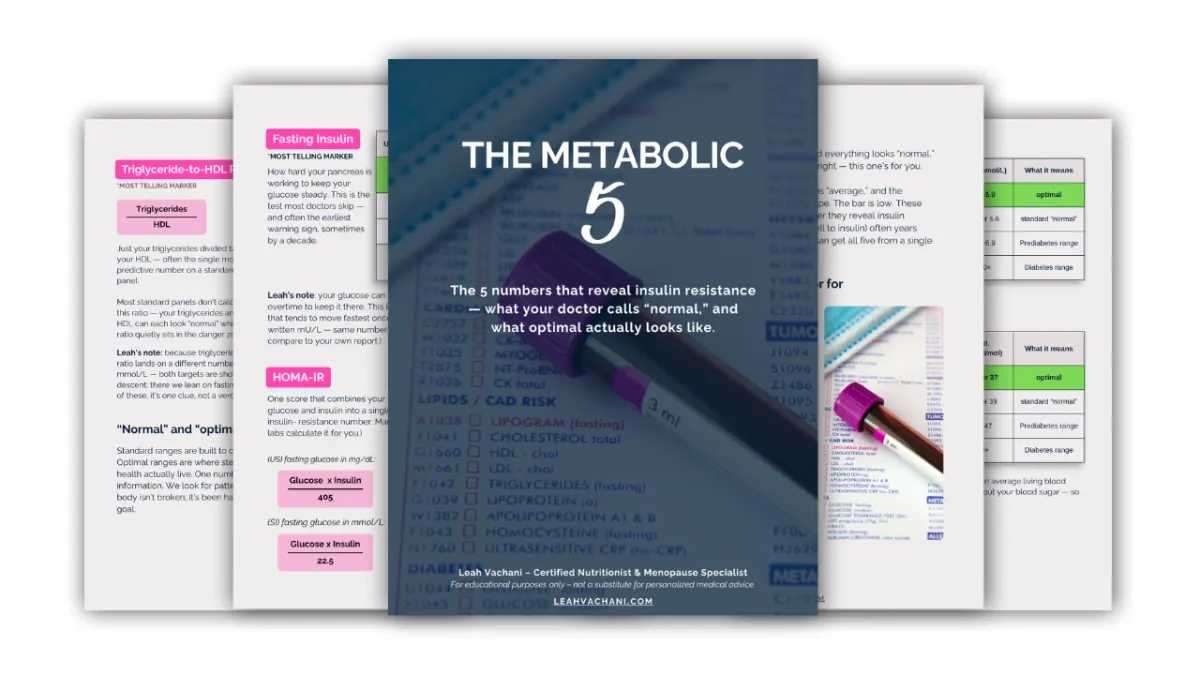
The Metabolic Five — my free guide to every metabolic test worth asking for, including the fasting insulin nobody offers you, and a printable list for your appointment. Download it here.
Clarity — my program for reading your own real-time glucose data. On your own, in a small group, or one-on-one with me. See current availability.
The Inner Circle — my monthly membership for women who want ongoing support. Join here.
Free Community — come and join us, no cost. Join here.
Fullscript — my practitioner dispensary, 15% community discount. Shop here.
AG1 — the greens powder I use daily. See it here.
AFFILIATE DISCLOSURE: Some of the links above are affiliate links, which means I may earn a small commission if you purchase through them, at no additional cost to you. I only recommend products I genuinely use and trust.
Sources
Zhang X, Gregg EW, Williamson DF, et al. A1C Level and Future Risk of Diabetes: A Systematic Review. Diabetes Care, 2010;33(7):1665–1673.
Robinson CA, Abdel-Motagally M. Comment on: Zhang et al. A1C Level and Future Risk of Diabetes. Diabetes Care, 2011;34(2):e20 — the published challenge to those figures, with the authors’ response alongside it.
Nichols GA, Hillier TA, Brown JB. Normal fasting plasma glucose and risk of type 2 diabetes diagnosis. The American Journal of Medicine, 2008.
DeFronzo RA. Banting Lecture. From the triumvirate to the ominous octet. Diabetes, 2009.
De Paoli M, Zakharia A, Werstuck GH. The Role of Estrogen in Insulin Resistance. The American Journal of Pathology, 2021.
Influence of Iron Deficiency on HbA1c Levels in Pregnant Women: Comparison with Non-Pregnant Women.
Medical disclaimer
A quick note from me: I’m a certified nutritionist and menopause specialist, but I’m not your doctor — and this article isn’t a substitute for personalized medical care. The information here is meant to inform and empower you, not replace a conversation with your healthcare provider. Always check in with your team before making changes to your diet, supplements, or lifestyle. Take what serves you, leave what doesn’t, and trust yourself.