How Many Carbs Does Your Body Really Need? ep #051
Summary
If you've been told your whole life to build your diet around carbohydrates, you're not alone — and you're also not wrong to be questioning it. The science has shifted. And for women in perimenopause and menopause, the carb conversation is more important, and more nuanced, than it's ever been.
How We Got Here
The story starts with a researcher named Ancel Keys. In the 1950s, Keys developed what became known as the diet-heart hypothesis — the idea that dietary fat causes heart disease. His Seven Countries Study, launched in 1958, was enormously influential, despite well-documented methodological problems, including the selective use of countries that supported his conclusions. By the 1980s, his ideas had fully shaped government policy and the food industry. Fat was stripped from products and replaced with sugar and refined carbohydrates. In 1992, the USDA food pyramid put grains at the base — and generations of women were handed a high-carb template as the definition of healthy eating.
The Part Nobody Told You
Here's a fact that tends to stop people mid-sentence: according to the National Academy of Medicine — formerly the Institute of Medicine — carbohydrates are not classified as an essential nutrient. Their 2005 Dietary Reference Intakes report states that the minimum amount of dietary carbohydrate compatible with life is effectively zero, provided you're getting adequate protein and fat. Your body can manufacture glucose on its own through a process called gluconeogenesis. Your brain will never starve for fuel simply because you didn't eat bread.
What Carbs Do — and Why Insulin Is the Real Story
All digestible carbohydrates break down into glucose. Glucose triggers insulin. Insulin signals your cells to take up that glucose for energy — and stores the overflow as fat once your glycogen tanks are full. Dr. Ben Bikman, whose research on insulin resistance has reshaped how we understand metabolic disease, has shown that chronically elevated insulin — driven by a consistently high-carb diet — is the master driver of fat storage, inflammation, and the cascade of symptoms that women in midlife know all too well: stubborn weight gain, energy crashes, brain fog, poor sleep, relentless cravings.
Why This Is a Different Conversation After 40
Estrogen does a lot of things most of us don't know about. One of them is acting as an insulin sensitizer — it helps your muscle cells take up glucose efficiently and keeps your blood sugar response stable. When estrogen starts declining during perimenopause, that buffer weakens. The ZOE PREDICT study — one of the largest real-world nutrition studies ever conducted, using continuous glucose monitors on over 1,000 women — found that post-menopausal women had 42% higher glucose responses to the same meals compared to pre-menopausal women. Same food. Dramatically different metabolic outcome. Based entirely on hormonal status.
Your brain feels it too. Dr. Lisa Mosconi at Weill Cornell Medicine has used PET scans to show that the female brain's glucose metabolism measurably declines during the menopausal transition — contributing directly to the brain fog, word-finding struggles, and cognitive haziness so many women experience. The hopeful part: ketones, the fuel your body produces when carb intake is low, can feed the brain through a different pathway, often restoring clarity even when glucose metabolism is impaired.
A Practical Framework
The goal isn't carb elimination — it's finding the carb level that matches your hormonal reality. A general guide: ketogenic (under 50g carbs/day) for a metabolic reset; low-carb (50–100g) for sustainable long-term eating; moderate-carb (100–130g) only if you're insulin-sensitive, very active, and eating exclusively whole food sources. Regardless of the level, the quality rule is non-negotiable: non-starchy vegetables, quality protein, healthy fats, and fiber-rich foods at every meal. Refined carbs, sweetened drinks, and industrial seed oils are out.
Know Your Numbers
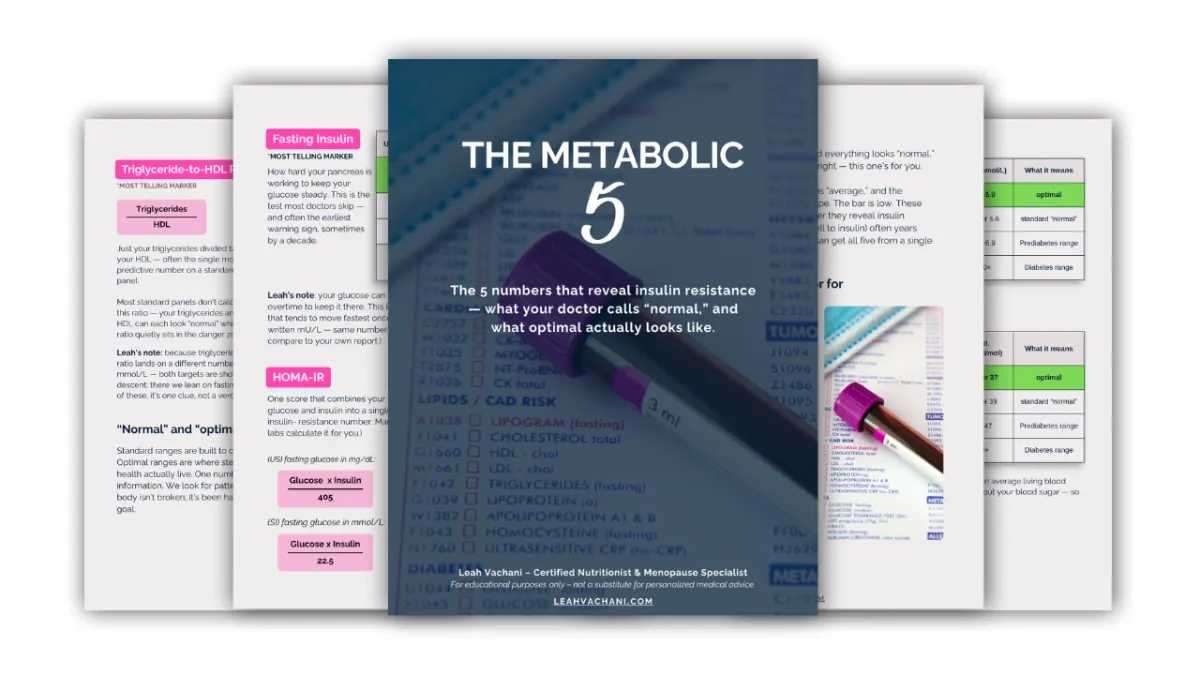
Ask your doctor for fasting insulin (not just glucose), hemoglobin A1C, HOMA-IR, triglycerides, and HDL. These markers tell the real metabolic story — and they often reveal insulin resistance a decade before a formal diagnosis. A continuous glucose monitor takes it further, showing you in real time exactly how your specific body responds to your specific food choices. That personalized data is the foundation of the CGM Metabolic Makeover program — because your metabolism isn't generic, and your nutrition strategy shouldn't be either.
Your body hasn't failed you. The food advice failed you. And now you have something better to work with.
Where to Listen:
The information provided during this podcast is for educational purposes only. The speaker may be a licensed medical professional and may present case studies of actual patients or refer to patients' treatment during the program. Please be reminded that the Scope of Practice for Holistic Nutrition Professionals prevents us from diagnosing, preventing, treating, curing, prescribing, managing, or healing disease. Holistic Nutrition Professionals are not licensed in any state and work with clients, not patients.
Chapters
00:00 Introduction to ACV and its popularity
01:04 Blood sugar regulation and hormonal changes in women over 40
01:51 Scientific evidence supporting ACV for blood sugar control
02:55 Mechanisms: How acetic acid improves glucose metabolism
04:15 Practical tips for using ACV safely and effectively
07:43 Limitations and realistic expectations of ACV benefits
09:39 Precautions and who should consult a healthcare provider
10:27 Summary: ACV as a research-backed tool for metabolic health
11:15 Encouragement to incorporate ACV and share knowledge
Key Studies & Research
ZOE PREDICT 1 Study — Berry et al., eBioMedicine / The Lancet (2022): 1,002 women; post-menopausal women showed 42% higher postprandial glucose responses vs. pre-menopausal women via CGM. https://www.thelancet.com/journals/ebiom/article/PIIS2352-3964(22)00485-6/fulltext
Ancel Keys — Seven Countries Study (launched 1958, published 1970–1986): foundational and contested diet-heart hypothesis. Keys' 1953 paper used only 6 of 22 available countries. https://www.sevencountriesstudy.com
DeFronzo RA — Lilly Lecture: 'The Triumvirate: Beta-Cell, Muscle, Liver.' Diabetes. 1988;37:667–687. (ADA Lilly Award, 1987)
DeFronzo RA — Canadian Diabetes Association Banting Lectureship (1988): 'Role of Insulin Resistance in Human Disease.' Diabetes. 1988;37:1595–1607.
DeFronzo RA — ADA Banting Award Lecture (2008): 'From the Triumvirate to the Ominous Octet.' Diabetes. 2009;58(4):773–795. https://diabetesjournals.org/diabetes/article/58/4/773/117
Mosconi L et al. — 'Perimenopause and emergence of an Alzheimer's bioenergetic phenotype in brain and periphery.' PLoS ONE. 2017;12(10):e0185926. (43 women; PET scans showing reduced brain glucose metabolism in peri/post-menopausal vs. pre-menopausal women)
Mosconi L et al. — 'Menopause impacts human brain structure, connectivity, energy metabolism, and amyloid-beta deposition.' Scientific Reports. 2021;11:10867. https://www.nature.com/articles/s41598-021-90084-y
Dietary Reference Intakes for Energy, Carbohydrate, Fiber, Fat... — U.S. Institute of Medicine / National Academy of Sciences (2005): source for 'zero carbohydrate' essential nutrient statement. https://nap.nationalacademies.org/read/10490/chapter/8
Carbohydrate Quality Index and Menopausal Symptoms — Mohsenian et al., Maturitas (2021): higher-quality carb intake associated with fewer somatic and psychological menopausal symptoms. https://pubmed.ncbi.nlm.nih.gov/34274075/
Nutrition in Menopause and Perimenopause: A Review — PMC / Nutrients (2024): comprehensive dietary recommendations during hormonal transition. https://pmc.ncbi.nlm.nih.gov/articles/PMC10780928/
🔥 Resources/Links Mentioned:
Books
Why We Get Sick — Dr. Ben Bikman (2020)
Fat Chance — Dr. Robert Lustig (2012)
Metabolical — Dr. Robert Lustig (2021)
The Obesity Code — Dr. Jason Fung (2016)
The Menopause Brain — Dr. Lisa Mosconi (2024)
The XX Brain — Dr. Lisa Mosconi (2020)
Grain Brain — Dr. David Perlmutter (2013)
Fast Like a Girl — Dr. Mindy Pelz (2022)
🎙️ Submit YOUR podcast question here or via written format here.
💚 FullScript Dispensary (My community gets a 15% discount!)
💚 AG1 Greens - With my special link, you will receive an exclusive subscription introductory offer worth $205 for only $79!
Connect with Leah...
✨ Follow Leah on Instagram for more value-packed content, tips, and lots of laughs!
✨ Subscribe to Women Aging Powerfully on YouTube for more free content.
✨ Join the free Women Aging Powerfully Facebook Community
✨ Listen to the Women Aging Powerfully Podcast
✨ Lose that stubborn belly weight, reclaim your energy ALL day, sleep better, and feel amazing with Leah's signature course
The information provided during this podcast is for educational purposes only. The speaker may be a licensed medical professional and may present case studies of actual patients or refer to patients' treatment during the program. Please be reminded that the Scope of Practice for Holistic Nutrition Professionals prevents us from diagnosing, preventing, treating, curing, prescribing, managing, or healing disease. Holistic Nutrition Professionals are not licensed in any state and work with clients, not patients.
NEED MORE HELP? Not sure where to start?
Here are some TOP resources to help you NOW!
STEP 1: Learn MORE from the Women Aging Powerfully Podcast
STEP 2: Connect with me on Instagram or YouTube, join the Women Aging Powerfully Facebook Community
STEP 3: Kickstart your weight loss goals and get epic results: The CGM Metabolic Makeover (Let's do this together!)
STEP 4: Lets chat about how I can further help you by booking a free