Creatine for Women Over 40: What the Research Actually Says
Supplement Spotlight
I Used to Think Creatine Was for Bodybuilders. Then I Read the Research.
For a long time, I mentally filed creatine under "not for me."
It felt like a supplement designed for "gym-bros" trying to get bigger. Something you'd see in a jug on the counter at GNC next to pre-workouts with names like BEAST MODE. No thanks, not my thing...
And then I actually dug into the research.
What I found completely changed how I think about it — especially for women navigating perimenopause and menopause. Because it turns out creatine isn't really a bodybuilding supplement. It's a cellular energy compound. And the research on what it does for muscle, bone, and brain after 40 is some of the most compelling I've come across.
So, I will try not to bore you with too much sciency-jargon (some of this is still over my head too), let me walk you through it in a way that will answer your questions. Ultimately, you just want to know, "is this something I should be taking?"...right?
What creatine actually is (and why you're already making some)
Here's something most people don't know: your body already produces creatine. Your liver makes about 1–2 grams a day. You also get some from meat and fish — about 1–3 grams depending on how much animal protein you eat. Vegans get almost none from food.
Creatine isn't a drug. It's not synthetic. It's a naturally occurring compound that your muscles, bones, and brain all use for energy — specifically for producing and recycling ATP, the fuel your cells run on during intense or sustained effort.
So why supplement? Because after 40, your natural stores decline. And research shows that getting a little more — through supplementation — has benefits that go well beyond muscle.
Dr. Darren Candow, one of the world's leading creatine researchers with over 140 published papers on the topic, calls it "conditionally essential." Not required to survive. But hard to fully replace through diet alone, and meaningfully beneficial when you add a little more. I find this to be exceptionally true when women are partaking in intermittent fasting.
What it does for muscle — and why this matters more than you think
Let's start here because this is the most researched area.
Creatine helps your muscles maintain energy during intense effort. It's especially effective for type 2 muscle fibers — the ones responsible for explosive movement, quick reactions, and the kind of strength that keeps you stable and independent. (All of that resistance training you're doing...right??)
Those are also the fibers we lose fastest after 40.
The loss of power and explosiveness is just as significant as the loss of muscle mass — and it's what affects your ability to catch yourself when you trip, carry groceries, get up off the floor.
Think of it this way. Your muscles store a form of energy called phosphocreatine — it's essentially a rapid refueling system that kicks in the moment you start lifting. By the time you get to your second, third, and fourth set, those stores are running low. That's when most people start grinding out fewer reps, or the weight feels noticeably harder.
What creatine does is keep that refueling system better stocked. So instead of fading in your later sets, you can maintain more of your output — more reps, more total work. And over weeks and months, that adds up. More work done consistently is what actually drives strength and muscle gains over time.
It also has anti-inflammatory and anti-catabolic effects, particularly during high-intensity training and long-duration endurance work — meaning it may help you recover faster and hold on to more muscle between sessions. Winning!!
Why perimenopause may actually be the right time to start
Here's something the research is only beginning to explore — and it's particularly relevant if you're in perimenopause or postmenopause.
Creatine's anti-catabolic effects — meaning its ability to help slow muscle breakdown — appear to work differently in women than in men. Researchers suspect estrogen and progesterone play a role in how the body responds to creatine. And as those hormones decline in midlife, the protection they once offered starts to go with them.
The implication is that women may actually need creatine more after menopause, not less. The natural hormonal buffer is reduced, muscle loss accelerates, and creatine may help fill some of that gap — particularly when combined with consistent resistance training.
This is still an emerging area of research, but it's one of the more compelling reasons this supplement deserves a closer look specifically for women in this life stage, not just athletes or "gym-bros".
The bone piece — and this one genuinely surprised me
Bone health is something we think about in terms of calcium and vitamin D. Creatine doesn't usually come up. But it probably should.
Research — primarily in postmenopausal women — shows creatine has what researchers call anti-resorptive effects on bone. It inhibits osteoclast activity, which is the cellular process responsible for breaking bone down. It essentially slows the erosion.
We're not talking about rebuilding bone from scratch. We're talking about meaningfully slowing the loss — particularly around the hip, which is where fractures tend to happen and where the consequences are most serious.
One important caveat the research is clear about: creatine needs weight-bearing exercise to work for bone (that's why you are always being told to "lift heavy things"). Alone, it doesn't move the needle much. But paired with resistance training, Candow's research shows it can help reduce bone mineral density loss in postmenopausal women.
The bone studies have generally used 8 grams per day — which is higher than the typical starting recommendation for muscle. That's something worth knowing if bone health is your primary motivation.
The brain piece (this is where it gets really interesting)
The brain is actually pretty resistant to creatine. It has its own production system and a strict blood-brain barrier that doesn't let much in from circulation. For healthy people in low-stress states, this usually isn't an issue — the brain makes what it needs.
But under stress? Sleep deprivation, aging, mental fatigue, jet lag? (Who isn't dealign with one of more of those factors?!) That's when supplemental creatine seems to matter most.
Higher doses — around 10 grams per day — have been shown to increase brain creatine content in imaging studies. Research suggests it supports memory and cognitive function particularly during periods of mental depletion. There's also emerging work on creatine as an adjunct in depression treatment — not a replacement for medication or therapy, but something that may support brain bioenergetics and help speed recovery alongside other interventions. I suggest doing a deep dive on this if it is really interesting to you.
The pattern here is consistent with what we see in muscle and bone: the more stressed the system, the more creatine seems to help.
How to actually take it
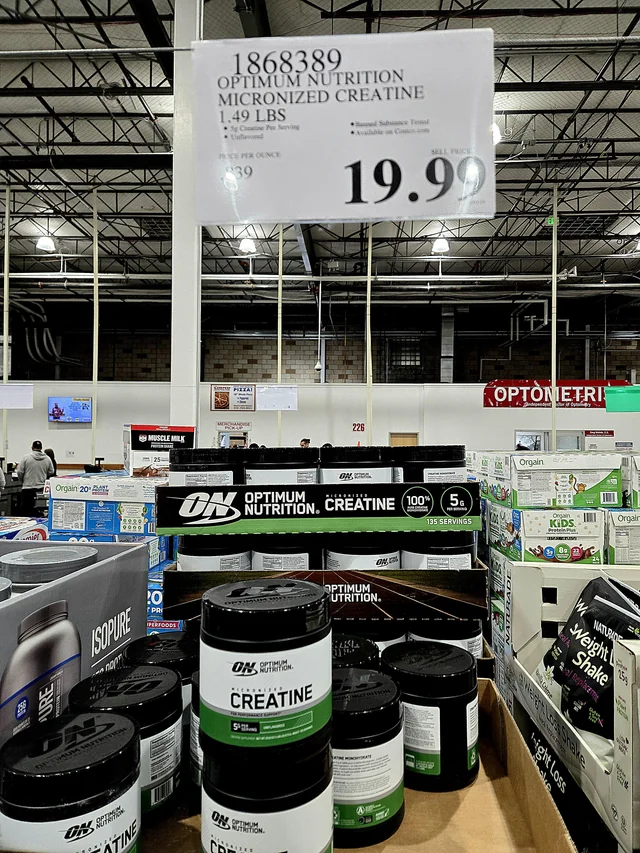
Creatine monohydrate is the only form backed by the research. Everything else — creatine HCL, ethyl ester, kre-alkalyn — is largely marketing. The bioavailability of monohydrate is nearly 100%. You don't need a fancier or more expensive version.
Look for third-party tested, pharmaceutical grade. If you see "Creapure" on the label, that's a good sign — it's a German-made monohydrate with rigorous purity standards.
For muscle: 3–5 grams per day. No loading phase needed. Your muscle stores will saturate in about 30 days.
For bone and brain too: 10 grams per day is where the research tends to point for broader benefits.
Timing: Doesn't matter much overall, but close to your workout — within an hour before or after — may give you a small advantage, but taking it anytime is the next best option.
GI issues: Split the dose. Half with breakfast, half with dinner. Take it with food, especially with protein or a meal containing carbs. This resolves most stomach complaints.
One important heads up: creatine raises creatinine in your blood, which can look like a kidney problem on a standard panel. It isn't — it's just the normal byproduct of creatine metabolism. But tell your doctor you're supplementing so they don't panic at your numbers!
What about water retention?
This comes up a lot, especially from women who've heard creatine causes bloating or weight gain. No one wants to add to the bloating and weight gain!
The old-school loading protocol — 20 grams per day for a week — does cause some water to move into your cells quickly, which can feel like puffiness. But that's not how most people should be taking it anyway.
Starting at 3–5 grams per day and building gradually, most women don't notice any meaningful change on the scale. Research in postmenopausal women using up to 11 grams per day showed no adverse effects. The water retention concern is largely tied to a protocol most of us have no reason to follow.
But won't it cause hair loss?
I hear this one a lot, so it's worth addressing directly.
The concern comes from a single study in rugby players that found creatine supplementation raised levels of DHT — a testosterone byproduct that's been linked to hair follicle thinning. It sounds alarming until you look closer. DHT levels went up but stayed within normal physiological range. No one measured actual hair loss. No dermatologist was involved. And in the decades since creatine research began, that finding has never been replicated.
Candow, who has studied creatine for decades and has put hundreds of participants through creatine trials, has never had a single person report hair loss as a side effect.
One small, unreplicated study measuring a surrogate marker is not the same as evidence that creatine causes hair loss. If that's been the thing holding you back, it probably shouldn't be.
So — is it worth it?
For most women over 40, yes. The evidence is strong, the safety profile is excellent, and the areas it supports — muscle, bone, brain — are exactly the things we're working to protect in midlife.
It's not a shortcut. It still requires the training, the protein, the sleep - you can't "out-creatine" a bad lifestyle. But if you're already putting in that work, creatine is a well-researched tool that can help you get more out of it. That's one more tool in your midlife toolbox!
I carry pharmaceutical-grade creatine monohydrate in my Fullscript dispensary — vetted, third-party tested, and ready to go.
Shop Creatine in My Dispensary →
Your community discount applies automatically.

Research note
The science in this post is grounded in published research by Dr. Darren Candow and colleagues — one of the most prolific creatine researchers in the world, with over 140 peer-reviewed papers. This post is for educational purposes and is not medical advice. Consult your healthcare provider before starting any new supplement.